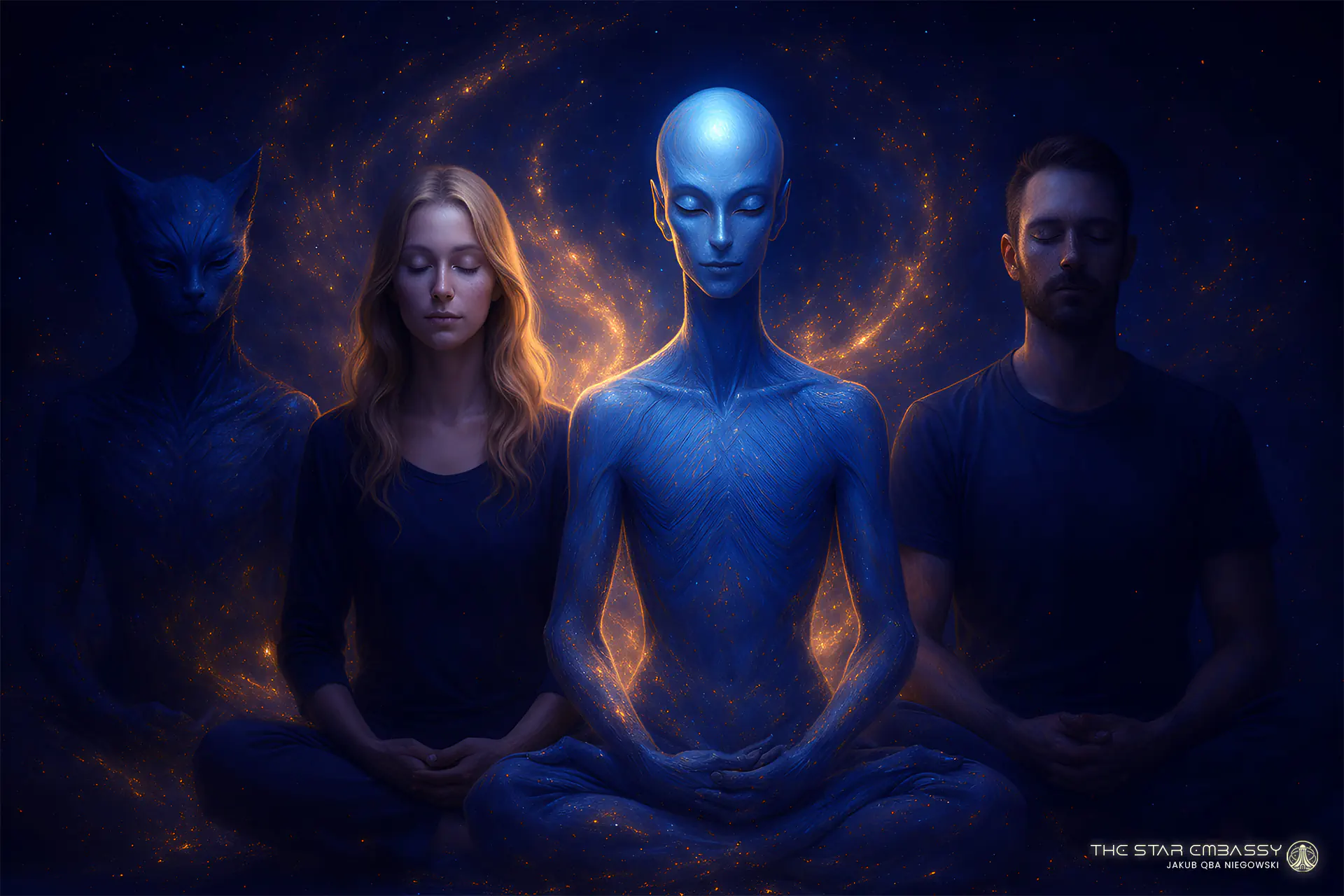
Lyran meditation is a set of consciousness practices inspired by the archetype of the Lyran civilization – an ancient, high-frequency collective of beings associated in esoteric traditions with boundless compassion, energetic perception, and cosmic wisdom. Rooted in the principle that transformation happens through presence rather than technique, Lyran meditation uses light visualization, heart-centered breathing, and empathic awareness to deepen intuition, dissolve emotional blockages, and attune the practitioner to subtler fields of consciousness.
If you are searching for a meditation practice that goes beyond breath-counting and body scanning – one that connects the personal and the transpersonal, the human and the cosmic – this guide offers three complete, step-by-step practices for every level, from first-time meditators to advanced energy workers.
Who Are the Lyrans – and Why Does It Matter for Meditation?
In the framework of extraterrestrial and starseed spirituality, Lyrans are described as one of the oldest interstellar civilizations, originating from the constellation of Lyra. They are considered guardians of consciousness – beings who operate not through direct intervention, but through subtle influence: inspiration, empathic resonance, and energetic transmission.
Their defining quality is not power or knowledge – it is heart intelligence: the ability to perceive the full spectrum of emotional reality without judgment, and to meet every experience – even suffering – with radiant compassion.
This philosophy is remarkably parallel to the Buddhist concept of Chenrezig (Avalokiteshvara), the Bodhisattva of Compassion, who vowed to remain present with all beings until every last form of suffering is dissolved. The convergence of these two traditions – cosmic and contemplative – forms the philosophical spine of Lyran meditation.
Understanding this context is not merely academic. It reshapes how you meditate. Instead of achieving a state, you are becoming a channel. Instead of quieting the mind, you are opening the heart.
How Is Lyran Meditation Different from Standard Mindfulness?
| Feature | Standard Mindfulness | Lyran Meditation |
|---|---|---|
| Primary focus | Breath / present-moment sensation | Heart field / light visualization |
| Goal | Mental calm, stress reduction | Cosmic connection, empathic expansion |
| Tradition | Buddhist / secular | Starseed / compassion cosmology |
| Technique-driven | Yes | No – presence-led |
| Emotional engagement | Observational | Active (compassion generation) |
| Suitable for | All practitioners | Especially resonant for empaths, starseeds, intuitives |
Both approaches are deeply valid. Lyran meditation is not a replacement for mindfulness – it is an extension of it, into territory that standard secular practice rarely explores.
What Are the Three Core Lyran Meditation Practices?
Practice 1: How to Begin Lyran Meditation as a Complete Beginner (“Silence of Light”)
Purpose: First contact with inner light; building a felt sense of safety and heart coherence. Recommended duration: 5-10 minutes daily. Best for: Anyone new to meditation or spiritual practice.
Step-by-step instructions:
- Sit comfortably in a chair or on the floor. Keep your spine gently upright.
- Place one hand over your heart center (the middle of your chest).
- Close your eyes. Breathe slowly in and out through your nose.
- Visualize a small, warm sun inside your chest – golden, steady, and radiating gently.
- On each inhale, allow this inner sun to grow brighter and expand through your body.
- On each exhale, imagine its light flowing outward – a quiet gift to all beings within your awareness.
- Stay in this presence for 5 to 10 minutes. Do not seek an experience. Simply be.
Closing the practice: Deepen your breath slowly. Before opening your eyes, press your palms lightly together in front of your heart and silently say: “May this light be a blessing for all beings.” Remain still for one minute before resuming activity.
Why it works: Heart-focused breathing has been studied extensively by the HeartMath Institute, whose research demonstrates that intentional positive emotion generation reduces cortisol, increases heart rate variability (HRV), and creates measurable shifts in the electromagnetic field of the heart – extending up to several feet from the body.
Practice 2: How to Develop Empathic Awareness Through Lyran Meditation (“Touch of the Space of Feelings”)
Purpose: Deepening emotional intelligence, processing suppressed emotional material, expanding compassion. Recommended duration: 15-20 minutes. Best for: Practitioners open to inner emotional work; empaths; those in healing professions.
Step-by-step instructions:
- Find a quiet, softly lit space – candlelight or twilight conditions are ideal.
- Sit or stand still. Feel the energetic atmosphere of the room without labeling or judging it.
- Ask yourself: “What emotions are present in my field right now?” – yours, and those that may belong to the space around you.
- Breathe slowly through your heart center, as if your heart has lungs of its own.
- Invite the question: “How can I meet this feeling – this pain, this fear, this heaviness – with compassion?”
- Allow answers to emerge spontaneously: as images, body sensations, warmth, or unexpected clarity.
- If a difficult emotion arises, do not push it away. Mentally wrap it in golden light – the way a parent holds a frightened child.
- Expand this embrace outward: first to yourself, then to people close to you, then to all beings experiencing similar pain anywhere in the world.
Closing the practice: Place both palms on your heart. Silently send compassion to three people – one you love, one who challenges you, and yourself. End with a gentle “thank you” to the space, to the practice, and to what arose. Set an intention: “May my heart remain open to the full range of life.”
Why it works: Research in compassion-based interventions – including those derived from Tibetan tonglen practice – shows significant reductions in emotional exhaustion and increases in prosocial behavior. The practice of deliberately attending to the emotional field without identification mirrors advanced techniques in somatic and trauma-informed therapy.
Practice 3: How to Achieve Deep Cosmic Connection in Advanced Lyran Meditation (“The Lyran Wave”)
Purpose: Synchronization with high-frequency light fields; opening as a channel for transpersonal intelligence; receiving intuitive guidance. Recommended duration: 20-30 minutes. Best for: Advanced meditators, energy workers, starseeds, and practitioners of remote viewing or channeling.
Step-by-step instructions:
- Choose a high-vibrational environment: nature settings, a space with crystals, or a room where you play 963 Hz solfeggio frequencies or compassion mantras (e.g., Om Mani Padme Hum).
- Sit in stillness. Spend three minutes simply arriving – releasing the day, releasing effort.
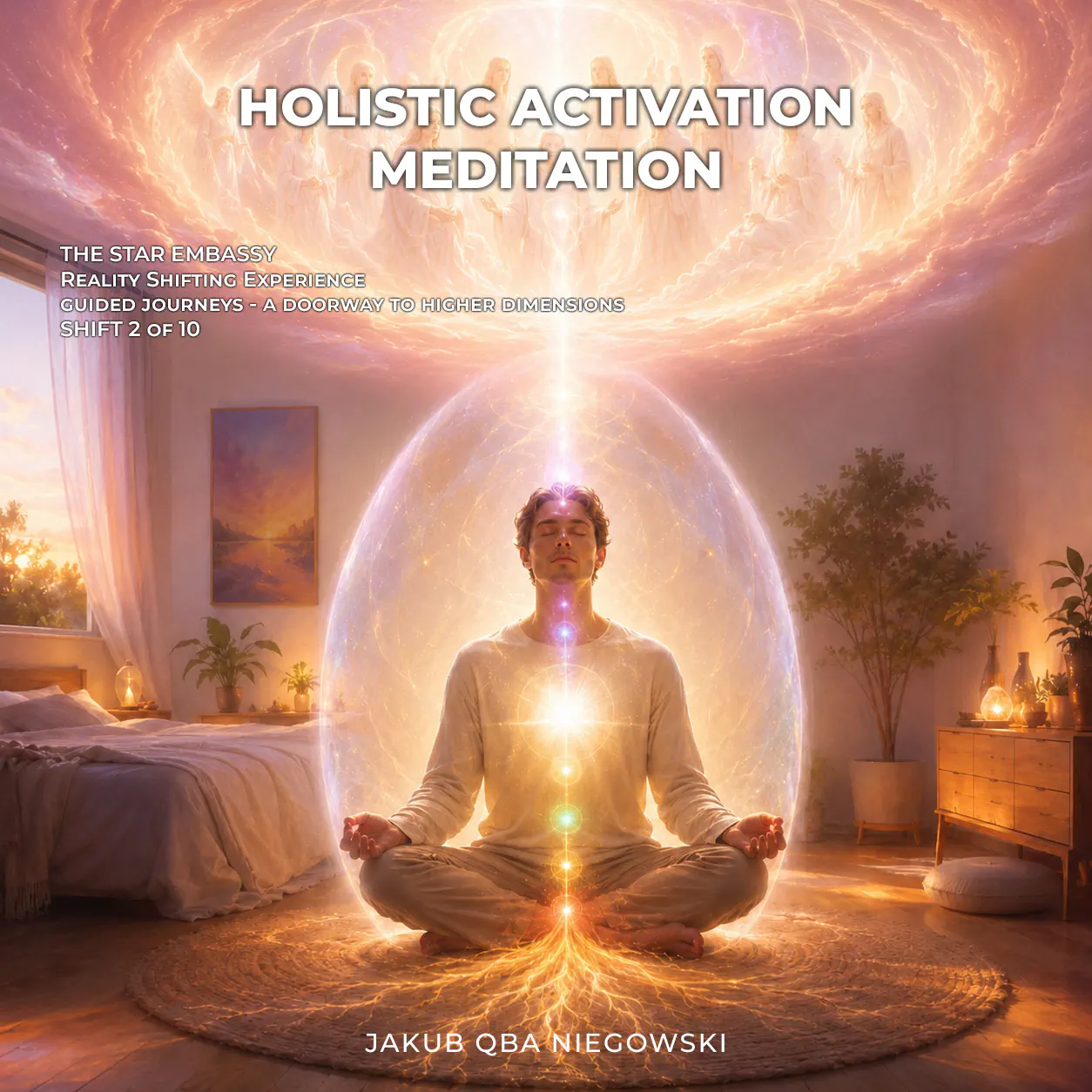
- Visualize a column of white-golden light descending from above, entering through your crown chakra (the top of your head).
- Allow this light to move slowly downward – through your brain, throat, heart, solar plexus, sacral center, and into the earth beneath you.
- As the light passes through each area, sense it clearing density, dissolving contraction, restoring coherence.
- Once the wave has passed fully through your body, rest in stillness. You are now a clear channel between the sky and the earth.
- Hold this openness. If images, words, impulses, or emotional knowings arise – allow them. Do not analyze. Simply receive.
- Sense your light connecting with a vast network of practitioners – every being in this moment who is meditating, praying, or holding frequency anywhere on Earth and beyond.
Closing the practice: Return your awareness gradually to your body, your room, your physical senses. If you received any message, image, or insight, write it down immediately – without interpretation. Let it sit. Its meaning will often clarify over hours or days. Close with the silent transmission: “May all beings in all dimensions be happy and free from suffering.”
Why it works: This practice integrates Crown-to-Root channel visualization with a non-local awareness framework consistent with descriptions of extended mind states studied in consciousness research (cf. Dean Radin’s work on entanglement and field consciousness). The “network of light” visualization activates a sense of belonging and transpersonal connection that reduces existential isolation – one of the most underacknowledged drivers of psychological suffering.
What Benefits Can You Expect from a Regular Lyran Meditation Practice?
Consistent practice across these three methods cultivates a progressive deepening of inner capacities:
- Expanded empathy and emotional range – you begin perceiving subtle emotional states in others and in environments, without becoming overwhelmed by them.
- Greater inner security – a felt sense that something larger holds and supports existence; anxiety naturally decreases.
- Intuitive clarity – spontaneous knowing about people, situations, and energetic dynamics that bypass ordinary analytical thought.
- Higher baseline frequency – practitioners often report feeling lighter, more present, and more harmonious in their daily interactions.
- Cosmic perspective – a lived recognition of yourself not only as an individual human, but as a node in a larger, luminous web of consciousness.
Expert Insights: What Makes Lyran Meditation Uniquely Effective for Sensitives?
From the perspective of an Extrasensory Awareness Development practitioner, one of the most significant limitations of mainstream meditation is that it was largely designed for – and validated through – neurotypical, low-sensitivity populations.
Standard mindfulness protocols teach practitioners to observe emotions without engaging them. For empaths and highly sensitive individuals, this creates an impossible paradox: the instruction to “observe” produces more hypervigilance, not less.
Lyran meditation resolves this tension by treating emotional sensitivity not as a liability to be managed, but as the primary instrument of the practice itself. Rather than stepping back from feeling, you learn to move through it – with structure, with compassion, and with the support of a cosmological framework that affirms your sensitivity as a gift.
The three practices mapped in this guide form a deliberate progression:
- “Silence of Light” establishes the safe container.
- “Touch of the Space of Feelings” trains the instrument (your emotional body).
- “The Lyran Wave” deploys that instrument at its full range.
This architecture mirrors the sequence used in advanced psychic and remote viewing training: ground, sensitize, then expand. The difference is that Lyran meditation does this within a context of unconditional compassion – which means the expanded states it opens tend to feel safe rather than destabilizing.
How to Build a Sustainable Lyran Meditation Routine
- Choose one practice at a time. Commit to a single method for at least seven consecutive days before exploring the next.
- Keep a spiritual journal. Record every session: what arose, how your body felt, any images or words that appeared – even those that seem trivial or “too strange.”
- Anchor with self-compassion. On days when nothing seems to happen – when the mind is loud, the heart feels closed – that is the practice. Meet the difficulty with the same gentleness you would offer any being in pain.
- Set an intention before every session. A simple, clear statement: “I practice this for the benefit of all beings, including myself.”
- Protect your energy field post-practice. After deep empathic or frequency work, take time to ground: walk barefoot, eat something light, drink water, be in nature.
Trusted External Resources and Research
For those who wish to explore the scientific and contemplative foundations of these practices further:
- HeartMath Institute – Research on heart coherence, HRV, and the heart’s electromagnetic field: heartmath.org
- The Institute of Noetic Sciences (IONS) – Peer-reviewed research on consciousness, intuition, and extended human capacities: noetic.org
- Dean Radin, Ph.D. – Real Magic and Entangled Minds – academic explorations of non-local consciousness and psi phenomena: deanradin.com
- Compassion-Based Interventions Meta-Analysis – Lim, D., et al. (2015): “Loving-kindness meditation reduces implicit intergroup bias”, PLOS ONE
- Tibetan Chenrezig Practice – Classical foundation for compassion meditation: The Bodhicaryavatara by Shantideva (8th century), widely available in modern translations
Frequently Asked Questions (FAQ)
Do you need to believe in extraterrestrials to practice Lyran meditation?
No. Lyran meditation works regardless of cosmological belief. The Lyran framework is best understood as a symbolic and archetypal container – similar to invoking a deity in a religious tradition. The psychological and energetic effects of the practice are real whether you interpret the Lyran beings as literal cosmic entities, symbolic aspects of collective consciousness, or simply a poetic framing for high-frequency compassion states.
How long does it take to notice results from Lyran meditation?
Most practitioners report subtle but distinct shifts – greater emotional ease, more vivid intuitive impressions, improved sleep, and reduced reactivity – within 7 to 14 days of consistent daily practice. Deeper transformations (expanded empathic perception, spontaneous insight, sustained states of inner peace) typically emerge after 30-90 days of dedicated work.
Can Lyran meditation be combined with other practices like Remote Viewing or breathwork?
Yes – and it often amplifies them significantly. Lyran meditation, especially the “Lyran Wave” practice, trains the same open-channel receptivity required for Remote Viewing, channeling, and deep somatic breathwork. It is an excellent preparatory or integrative practice for any protocol that requires the practitioner to move beyond normal cognitive filtering.
Is Lyran meditation safe for people with anxiety or emotional trauma?
The first practice (“Silence of Light”) is gentle enough for almost anyone, including those with anxiety. It builds the sense of safety and containment that all deeper work requires. The second and third practices engage the emotional and energetic field more actively – these are best approached once the first practice feels stable and grounding. If you are in active trauma processing, work with a qualified therapist alongside any energy or meditation practice.
What is the best time of day to practice Lyran meditation?
Early morning (within one hour of waking) and late evening (within one hour before sleep) are considered optimal. The mind is closest to the hypnagogic threshold at these times – more permeable to subtle impression, imagery, and intuitive signal. Even 10 minutes at dawn practiced consistently outperforms 45-minute sessions done irregularly.
Jakub Qba Niegowski – Extrasensory Awareness Development Specialist
You can support this practice with our guided meditation recordings.