




HANDBOOK X
RPG of Multidimensional Exploration & Awakening
Jakub Qba Niegowski
COMBAT MECHANICS FOR SPACECRAFT
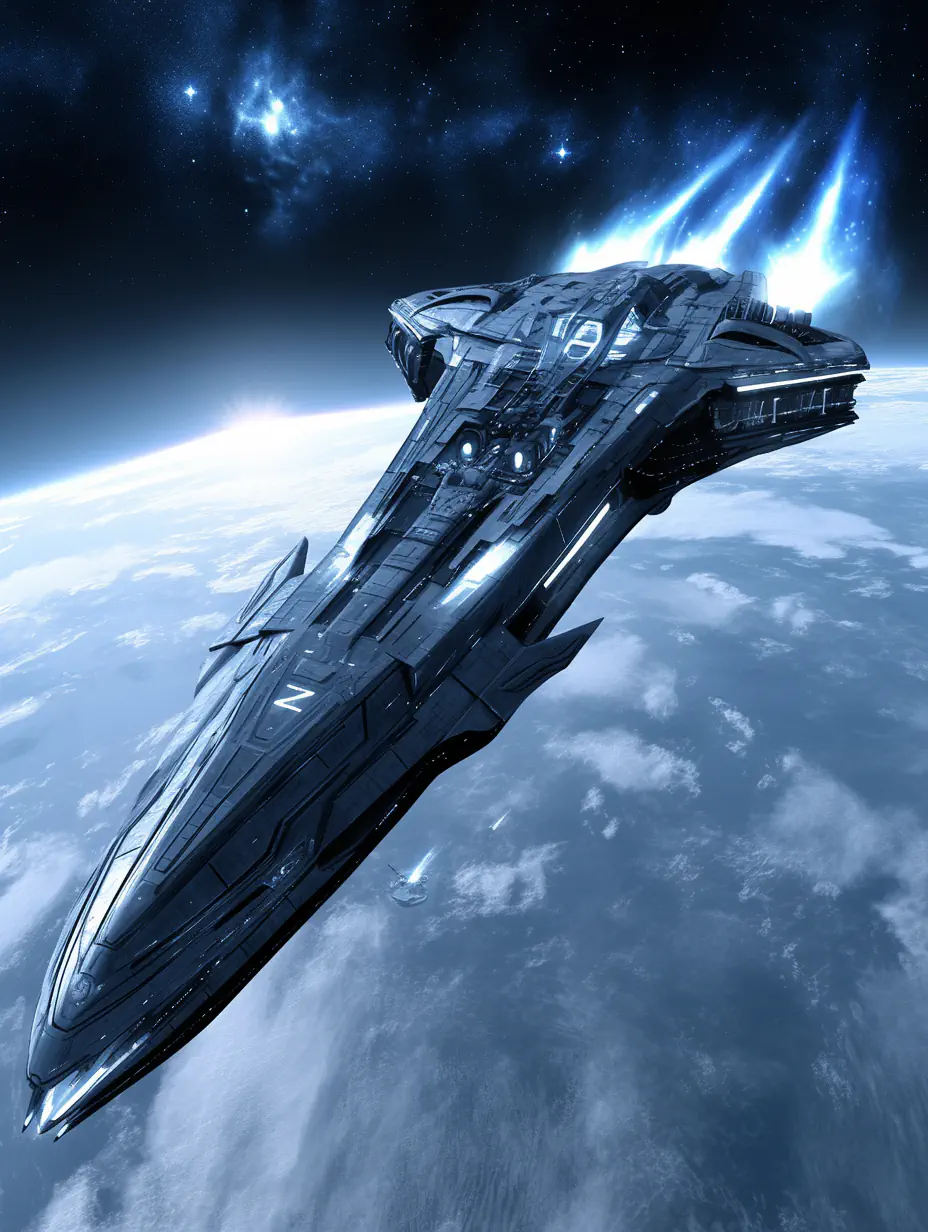
1. Attributes for Spacecraft
- Hull Plating: The durability of the ship’s outer shell against damage.
- Force Field: An additional layer of energy protection.
- Armament: The ship’s offensive power.
- Sensors: Precision of sensors and targeting systems.
- Reactor: Power available to supply the ship’s systems.
- Maneuverability: Ability to perform maneuvers and avoid attacks.
- Engines: Speed and ability to travel interstellar distances.
- Cargo Capacity: Cargo capacity and ability to carry heavy loads. Cargo capacity is measured in tons from 1 to 100 maximum and applies only to trade goods. Regular user items do not take up cargo space and can be freely stored on the ship.
2. Initiative
- Each ship at the start of combat rolls 1d10 and adds the result to the ship’s Maneuverability attribute.
- Ships act in order from highest to lowest result.
3. Actions per Turn
- Each ship has 2 action points (AP) per turn.
- Each action costs 1 action point.
- Possible actions:
- Movement: Move one distance unit.
- Main weapon shot: Execute an attack with main armament.
- Secondary weapon shot: Execute an attack with secondary armament.
- System repairs: Repair damaged ship systems.
- Defensive maneuvers: Execute a defensive maneuver.
- Other actions: At GM’s discretion.
4. Attacks and Defense
- Attack: Roll 1d10 and add the appropriate ship attribute (Sensors for accuracy, Maneuverability for maneuvering). Compare the result with difficulty level 10.
- If the result is equal to or higher than 10, the attack hits.
- If the result is lower, the attack misses.
- Defense: A ship can defend itself by executing defensive maneuvers (roll 1d10 + ship’s Maneuverability).
5. Damage
- Damage depends on the ship’s armament. Each weapon has assigned damage.
- For energy weapons: base damage + ship’s Reactor modifier.
- For kinetic weapons: base damage + ship’s Armament modifier.
6. Hit Points (HP)
- Each ship has Hit Points (HP) calculated as 10 + ship’s Hull Plating attribute.
- When a ship’s HP drops to 0, the ship is damaged and requires repairs.
EXAMPLE SPACECRAFT CARD
SHIP NAME: USS EXPLORER
Ship Attributes:
- Hull Plating (armor): 9
- Force Field: 7
- Armament: 8
- Sensors (perception): 8
- Reactor (energy resources): 7
- Maneuverability (agility, dodge): 8
- Engines: 7
- Cargo Capacity: 6
Hit Points (HP): 19 (10 + 9)
Armament:
- Main Energy Cannon: Damage 5 + Reactor modifier
- Secondary Armament: Damage 3 + Armament modifier
Systems:
- Defensive Systems: Defensive maneuvers (1d10 + ship’s Maneuverability)
- Communication Systems: +1 to interactions with other ships and civilizations
- Repair Systems: +1 to repairs during combat
TYPES OF SPACECRAFT
1. FIGHTER
SMALL, AGILE SHIP DESIGNED FOR QUICK ATTACKS AND ESCORT
- Hull Plating: 4
- Force Field: 3
- Armament: 6
- Sensors: 7
- Reactor: 5
- Maneuverability: 9
- Engines: 8
- Cargo Capacity: 2
2. Frigate
Versatile medium-sized ship, ideal for groups of adventurers.
- Hull Plating: 6
- Force Field: 6
- Armament: 7
- Sensors: 7
- Reactor: 6
- Maneuverability: 6
- Engines: 7
- Cargo Capacity: 5
3. Cruiser
Large warship, powerful and well-armed.
- Hull Plating: 8
- Force Field: 8
- Armament: 9
- Sensors: 8
- Reactor: 8
- Maneuverability: 5
- Engines: 6
- Cargo Capacity: 7
4. Research Vessel
Specialized unit for exploration and scientific research.
- Hull Plating: 5
- Force Field: 5
- Armament: 4
- Sensors: 10
- Reactor: 7
- Maneuverability: 5
- Engines: 6
- Cargo Capacity: 8
5. Transport Ship
Large merchant vessel, optimized for cargo transport.
- Hull Plating: 7
- Force Field: 4
- Armament: 3
- Sensors: 5
- Reactor: 6
- Maneuverability: 3
- Engines: 5
- Cargo Capacity: 10
6. Scout Ship
Fast and discreet ship for reconnaissance and espionage missions.
- Hull Plating: 5
- Force Field: 5
- Armament: 5
- Sensors: 9
- Reactor: 7
- Maneuverability: 8
- Engines: 9
- Cargo Capacity: 3
7. Destroyer
Medium-sized warship, combining firepower with mobility.
- Hull Plating: 7
- Force Field: 7
- Armament: 8
- Sensors: 8
- Reactor: 7
- Maneuverability: 6
- Engines: 7
- Cargo Capacity: 4
8. Colony Ship
Enormous vessel designed for long-duration journeys and establishing colonies.
- Hull Plating: 9
- Force Field: 6
- Armament: 5
- Sensors: 7
- Reactor: 9
- Maneuverability: 2
- Engines: 4
- Cargo Capacity: 10
9. Luxury Yacht
Exclusive ship for VIP and diplomatic travel.
- Hull Plating: 6
- Force Field: 7
- Armament: 4
- Sensors: 6
- Reactor: 8
- Maneuverability: 7
- Engines: 8
- Cargo Capacity: 6
10. Flagship
The largest and most powerful ship in the fleet, command center.
- Hull Plating: 10
- Force Field: 10
- Armament: 10
- Sensors: 9
- Reactor: 10
- Maneuverability: 3
- Engines: 5
- Cargo Capacity: 9
SPECIAL ABILITIES OF SPACECRAFT
- Phasing (only living ships from higher dimensions)
- Cloaking: Ability to temporarily hide from enemy sensors.
- Hyperspace Jump: Ability to instantly move short distances.
- Force Field Regeneration: Faster renewal of energy shields.
- Overcharged Reactor: Temporary increase in reactor power at the cost of stability.
- Ion Weapon: Special armament capable of temporarily disabling enemy systems.
- Advanced Sensors: Increased ability to detect cloaked units.
- Holographic Projection: Creating false ship images to deceive the enemy.
- Automatic Repair System: Faster repair of damage during combat.
- Deflector Shield: Increased resistance to a specific type of weapon.
- Gravity Hook: Ability to attract or repel other ships.
MECHANICS OF SPACECRAFT TRAVEL
Interstellar travel is an integral part of space adventures. This section describes how to play out spacecraft travel and what challenges players may encounter during their expeditions.
Travel Distances
The Game Master determines the distance to the travel destination using three categories:
- Close: Travel within a single star system or to the nearest neighboring systems.
- Medium: Travel through several star systems or to more distant parts of the sector.
- Far: Long journey through a significant part of the galaxy or to distant, rarely visited regions.
Travel Test Mechanics
- The player makes a d10 roll for their ship:
- For “Close” travel: 1 roll
- For “Medium” travel: 2 rolls
- For “Far” travel: 3 rolls
- For the test to be successful, the result of each roll must be lower than the ship’s Engines attribute value.
- If all rolls are successful, the journey proceeds without complications.
- If at least one roll fails, a complication occurs (see table below).
Example: The players’ ship has an Engines attribute value of 7. They are traveling a “medium” distance, so they make 2 rolls:
- 1st roll: 5 (successful)
- 2nd roll: 8 (failed)
The journey ends in a complication.
Travel Complications Table (d6)
- Pirate Raid: The ship is attacked by space pirates.
- System Failure: A random ship system malfunctions and requires repair.
- Cosmic Anomaly: The ship encounters a dangerous anomaly (ion storm, asteroid field, etc.)
- Unplanned Stop: Necessity to land on the nearest planet to replenish supplies or make repairs.
- Navigation Interference: The ship veers off course, extending the journey by 50% time.
- Unexpected Encounter: Contact with an unknown race or cosmic phenomenon.
Travel Modifiers
- Experienced Navigator: If one of the crew members has high Astrogation skill (8+), add +1 to the Engines attribute for the test.
- Advanced Star Maps: Possessing current galactic maps adds +1 to the Engines attribute.
- Damaged Ship: If the ship has less than half its Structure Points, subtract -2 from the Engines attribute.
Travel Time
Travel time depends on distance and can be modified by the test result:
- Close: 1d4 days
- Medium: 1d4 weeks
- Far: 1d4 months
In case of complications, the GM may increase travel time by 50-100%.
Events During Travel
Even if the travel test is successful, the GM may introduce various events to enrich the adventure:
- Discovery of an unknown planet or cosmic phenomenon
- Receiving an SOS signal from a nearby ship
- Unexpected encounter with another race or faction
- Internal conflict or problem on the players’ ship
- Discovery of a valuable deposit of resources or artifact
Tips for the GM
- Use travel mechanics to build tension and create opportunities for new adventures.
- Adjust travel difficulty to the players’ experience level and the condition of their ship.
- Allow players to creatively solve problems during travel complications.
- Use travel time for character development, team relationships, and planning future missions.
Summary
The mechanics of interstellar travel add an element of uncertainty and adventure to space exploration. Remember that the journey can be just as exciting as the destination itself – use this time to enrich the story and players’ experiences in the fascinating world of the game.
This is not the final version of the HANDBOOK X. If you want to help it grow into its full, epic form, you can support the project at buymeacoffee.com/TheStarEmbassy.