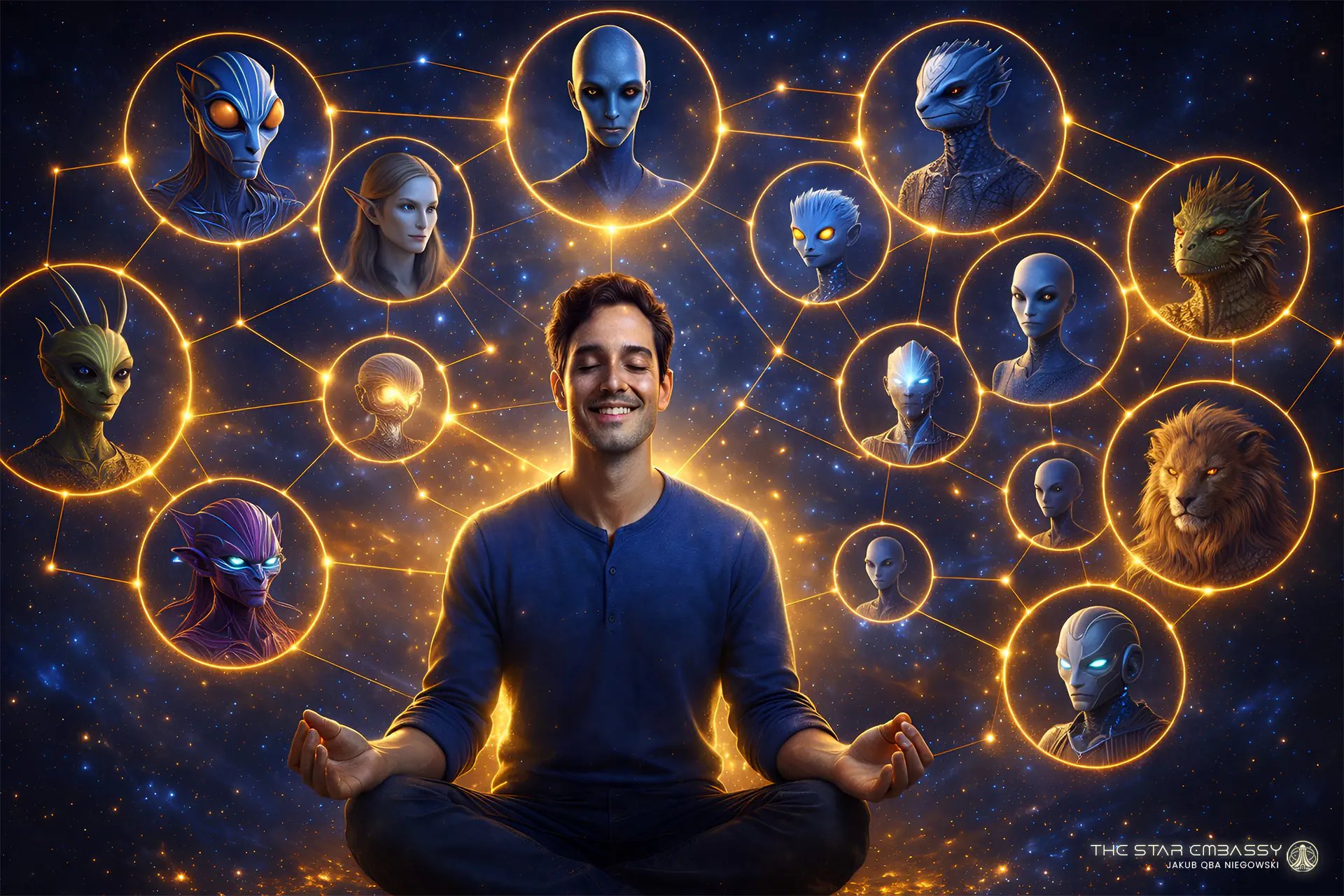

Astral projection (OOBE, Out of Body Experience) is the experience in which a person’s consciousness extends beyond their physical body and perceives reality from a perspective unavailable to the ordinary senses. This isn’t a theory – it’s a phenomenon documented by researchers, reported by millions of people worldwide, and subjected to systematic scientific study for over half a century.
Human beings are far more than their physical bodies. Most of us sense this intuitively – and that intuition is entirely correct. Reality is multilayered, and astral projection is one of the most direct ways to discover that for yourself.
What Is the Astral World?
The astral world is a realm of existence that extends beyond the physical dimension. It can also be described as a non-material, spiritual, or extrasensory reality – the names change, but the essence remains the same.
This realm is not uniform. It encompasses many levels – from those closest to everyday physical reality that mirror it, to regions of an entirely different character that some associate with higher-vibration dimensions, the space of the higher Self, or environments of highly developed conscious beings.
Various philosophical traditions have attempted to classify this, creating divisions into the astral world, mental world, buddhic plane, and so on. In practice, however, these boundaries are conventional. There is no “sign” marking where one world ends and the next begins. These classifications are merely useful tools – like a scale on a thermometer – not separate, isolated dimensions.
For the purposes of this article, I use “astral world” to mean the whole space in which our non-physical consciousness can exist and have experiences. Astral projection is a journey through the various levels and places within that space – accomplished through focused intent, will, and the right method.
What Are the Forms of Astral Projection and Out-of-Body Travel?
There is no single path to out-of-body experiences. At least five distinctly different forms are known – and each has its own requirements, difficulty level, and degree of reliability in the information it yields. They are compiled below, arranged from the most spectacular to the most precise.
Is OOBE the Most Powerful Form of Astral Projection?
OOBE (Out of Body Experience), also known as exteriorization, is the most intense form of out-of-body experience. It is characterized by a complete, subjectively real sense of separation from the physical body – the person literally knows they are outside their body and can move through space by pure act of will.
The greatest researcher and popularizer of OOBE was Robert Monroe, author of the classic trilogy: Journeys Out of the Body, Far Journeys, and Ultimate Journey. Monroe founded an institute researching altered states of consciousness that continues to document these experiences to this day.
Why Is OOBE So Difficult?
Having experienced OOBE many times personally, I’ll state it as a practitioner: it is not an optimal form for people just beginning to explore. There are several reasons.
For OOBE to occur, a series of energetic and psychological conditions must all be met simultaneously. In the out-of-body state, every thought triggers immediate movement – lack of control over the thought stream causes chaotic displacement. Fear (natural when experiencing full separation from the body) very easily destabilizes the entire experience and “tunes” consciousness to lower-vibration regions of astral space. Only a small percentage of practitioners are able to regularly enter OOBE and consciously direct it.
The value of OOBE is, however, unparalleled in one respect: it provides absolute, personal certainty that consciousness can exist outside its physical shell. It is an experience that changes one’s worldview forever.
What Are Mental Journeys and Why Does Imagination Hinder Them?
Mental journeys are a form of projection that does not require losing contact with the physical body. They are accomplished by focusing attention on a chosen location or target and receiving the images and information flowing from there.
The popularizer of this method was Bruce Moen – a participant in Monroe Institute programs who, despite being unable to achieve full OOBE, discovered he could perceptually reach the same places described by people in states of exteriorization. His books are a valuable complement to Monroe’s work.
The human mind is a simulation tool. Our brains are evolutionarily designed to fill information gaps – they generate imagery in advance, predict outcomes, and draw inferences based on knowledge we already possess. In the practice of mental journeys, this means one thing: when we know the target, imagination immediately begins “constructing” it from existing fragments of knowledge, films, books, and beliefs. That is not extrasensory perception – that is simulation.
For this form of travel to yield reliable results, one must spend many years learning to distinguish actual perception from one’s own creation. Few people manage this.
Can Dreams Be Treated as a Form of Astral Travel?
Yes – and this is an aspect of dreaming that is rarely discussed honestly.
Dreams unfold at different levels of the astral realm. The most typical dream creates something like a temporary “bubble” of reality that forms and dissolves in non-physical space – which is why it’s possible to visit each other in dreams, because that space genuinely exists momentarily. Dreams in which we feel present in a completely foreign, autonomous world take on a far deeper dimension – we encounter unknown beings, enter places with no counterpart in physical reality. These are largely traces of real astral journeys our consciousness undertakes during sleep.
Lucid dreaming practices allow us to participate in this process more consciously – however, we are then usually still immersed in the space of our own subconscious, which makes it difficult to reach regions beyond our own creation.
What Is Shamanism as a Path to the Astral World?
Shamans have been entering the non-physical realm for millennia for diagnostic, healing, and informational purposes. Shamanic journeys were – and continue to be – a real form of exploring the astral world, enabling contact with guides and access to knowledge unavailable through ordinary senses.
Traditional shamanism was a path of years-long, rigorous preparation. The practices that remain with us in the form of romantic narratives are only part of the process – the visible, “spectacular” part. Invisible is the long road of discipline and understanding, without which spectacular tools become dangerous. Today we have methods that allow crossing the threshold of the astral world without consciousness-altering substances. What might be called New Shamanism is based on knowledge of the mechanisms of mind and conscious perceptual techniques – not pharmacological shortcuts.
Why Is Remote Viewing the Most Precise Form of Astral Exploration?
Remote Viewing is a technique developed through U.S. intelligence research during the Cold War. Its goal was to create an optimal method of extrasensory perception – one that eliminates the most fundamental problem of all previous forms: the interference of imagination.
Remote Viewing combines elements of mental journeying – the person does not leave the body and remains in full contact with physical reality – but operates on entirely different procedural principles.
Key innovations of Remote Viewing:
- Target identifier – instead of knowing the target in advance, the perceiver (Remote Viewer) receives only a random series of digits assigned to the target by the monitor. This prevents imagination from activating, because there is no anchor point for associations.
- Separation of perception from analysis – during an RV session the monitor asks neutral clarifying questions; the Remote Viewer focuses solely on reception. Analysis happens separately.
- Verifiability – session results can be compared against reality. This makes Remote Viewing the only form of astral exploration that submits to systematic verification.
- Repeatability across a group – when several independent Remote Viewers investigate the same target without mutual contact, overlapping elements become strong candidates for objective information. No other method offers this level of certainty.
Remote Viewing is also accessible – it does not require years of shamanic preparation, it does not require leaving the body, and it is not dependent on a lucky alignment of conditions like OOBE. It is a method that can be learned.
Comparison of Astral Projection Forms
| Form | Experience Intensity | Difficulty | Imagination Interference | Verifiability |
|---|---|---|---|---|
| OOBE (exteriorization) | Very high | Very high | Low | Difficult |
| Mental journeys | Medium | High | Very high | Difficult |
| Dreams / Lucid Dreaming | Variable | High | High | Very difficult |
| Shamanism | High | Very high | Medium | Difficult |
| Remote Viewing | Subtle | Medium | Low (protocol eliminates) | High |
Why Do Most People Fail to Achieve Lasting Results in Astral Projection?
After many years of working with people developing extrasensory perception, one recurring pattern emerges: most people look for a shortcut to an intense, spectacular experience. OOBE tempts because it promises an immediate, undeniable answer to the question “am I more than just a body?”
The problem is that the intensity of an experience is not the same as its informational quality or the durability of its results. One can leave the body many times and learn nothing that couldn’t have been inferred from imagination alone. One can have thousands of fascinating dreams and gain no verifiable information.
A mature approach to astral projection means stopping the chase after an experience and starting to build capacity. These two goals lead in different directions. Remote Viewing is paradoxically less spectacular than OOBE – and at the same time far more valuable for someone who genuinely wants to develop their consciousness and perceptual abilities. It is methodical, repeatable mental training – not a one-time spectacular event.
Sources and Research
- Monroe, R. A. (1971). Journeys Out of the Body. Doubleday.
- Moen, B. (1997). Voyage to Curiosity’s Father. Hampton Roads.
- Targ, R., Puthoff, H. (1977). Mind-Reach: Scientists Look at Psychic Ability. Delacorte.
- Morehouse, D. (1996). Psychic Warrior: Inside the CIA’s Stargate Program. St. Martin’s Press.
- Ehrsson, H. H. (2007). The Experimental Induction of Out-of-Body Experiences. Science, 317(5841), 1048.
- Radin, D. (2013). Supernormal: Science, Yoga, and the Evidence for Extraordinary Psychic Abilities. Deepak Chopra Books.
FAQ – Frequently Asked Questions About Astral Projection and OOBE
Is astral projection safe? Astral projection as a form of consciousness exploration is generally safe for mentally stable individuals. The greatest risk comes from lack of preparation – especially with OOBE, where intense fear can lead to unpleasant experiences. Remote Viewing is the safest of all forms because it occurs with full bodily contact and in controlled conditions.
What is the difference between OOBE and lucid dreaming? In a lucid dream you know you’re dreaming, but you remain immersed in an environment created by your own subconscious. In OOBE, consciousness perceives itself as being outside the physical body in a space that has qualities of independence from your psyche. The boundary can be blurry, but the key is that the OOBE environment exhibits autonomy independent of the dreamer’s will.
Can anyone learn to leave their body? Full OOBE is accessible to only a portion of people – and even among them, few achieve lasting control over it. Remote Viewing, which is also a form of astral exploration, can be developed by the vast majority of people – it is a trainable skill, not an innate gift.
What is the silver cord in astral projection? The silver cord (silver thread) is an element described by many people experiencing OOBE – a subtle connection between the astral and physical body that guarantees the ability to return. In esoteric tradition it serves as a sort of “anchor” of identity. In the research literature it is treated as a subjective element of the experience, though its description appears independently across many different cultures.
How long does it take to learn Remote Viewing? First verifiable results appear in most people after just a few practice sessions. Building a solid, repeatable ability is a process of several months of regular practice. Mastering the protocol to a level allowing work with difficult targets typically takes a year or more.
Jakub Qba Niegowski – Extrasensory Awareness Development Specialist
If you want a gentler way in, our guided meditation recordings help you reach the relaxed, focused state these experiences depend on.