



HANDBOOK X
RPG of Multidimensional Exploration & Awakening
Jakub Qba Niegowski
CONCEPT OF LOWER AND HIGHER KNOWLEDGE
Definition and Characteristics:
LOWER KNOWLEDGE:
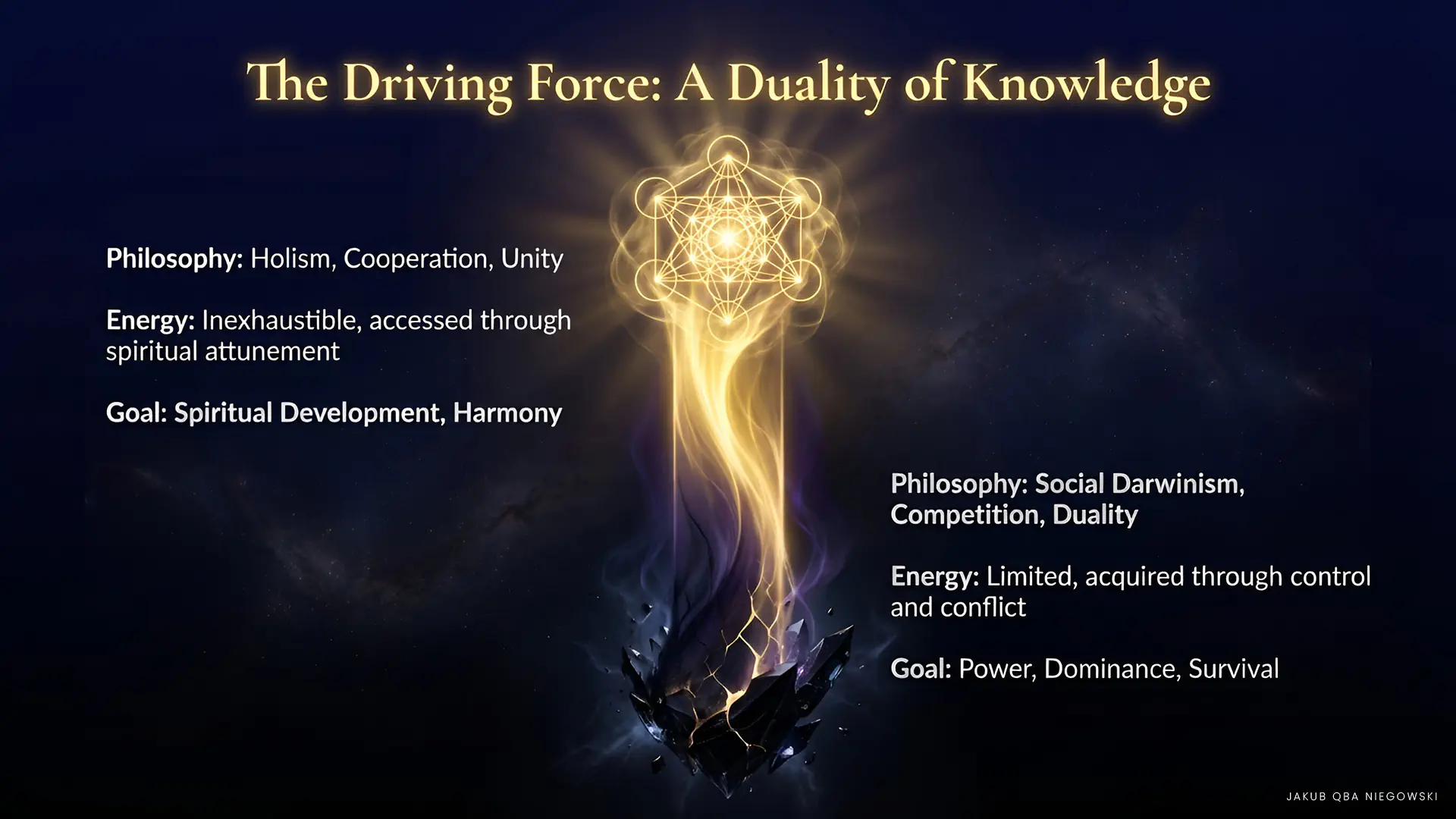
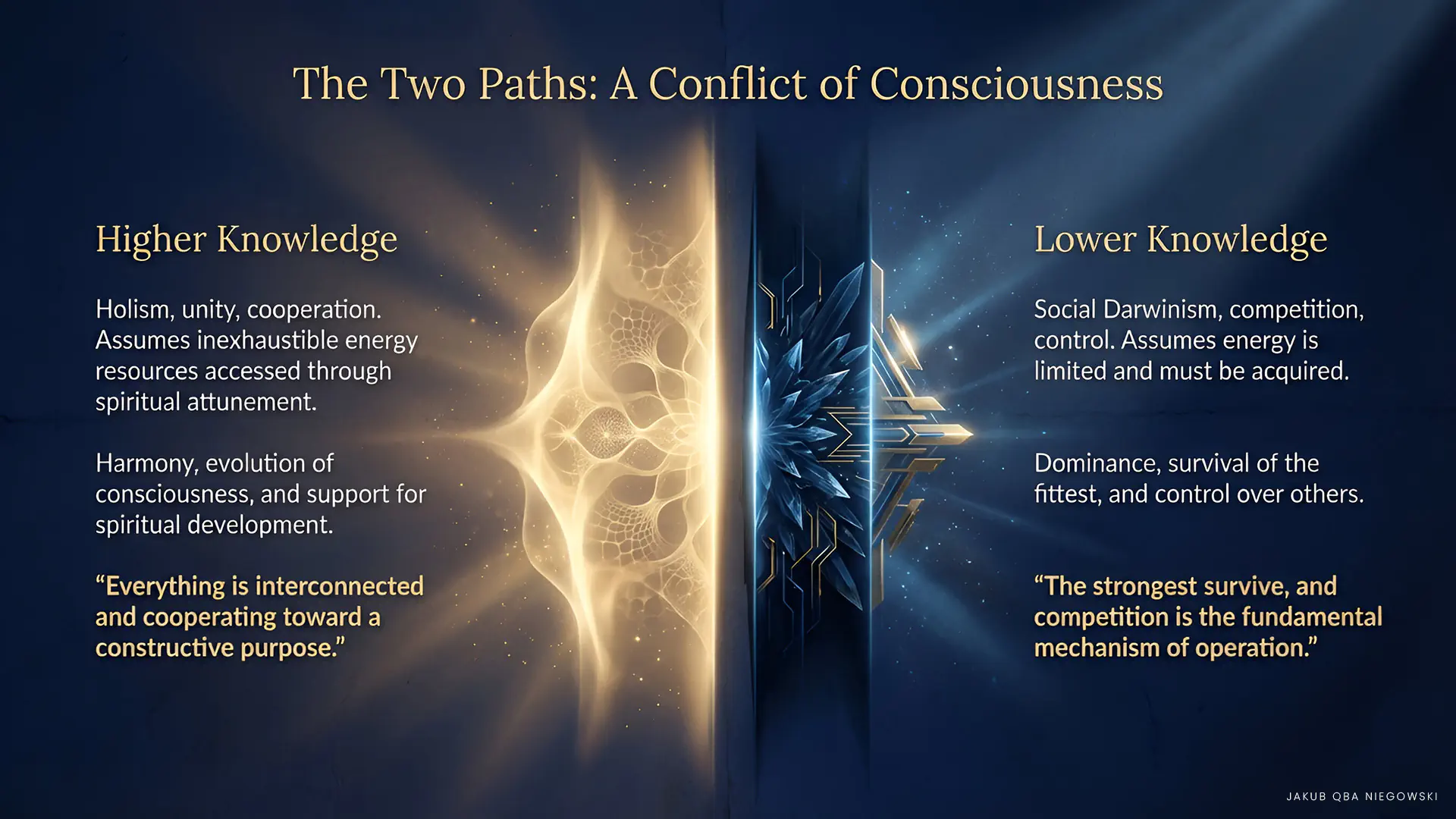
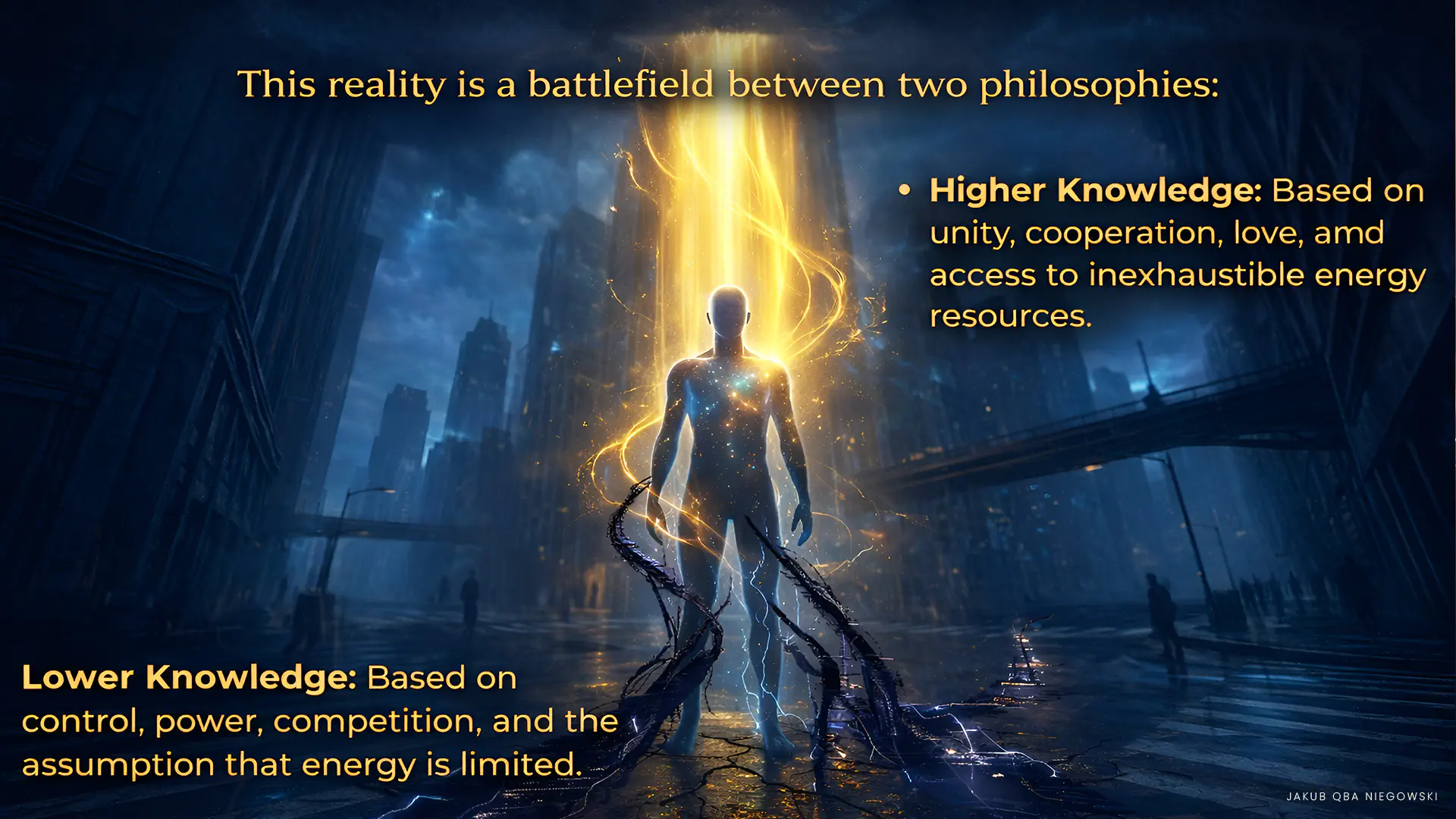
- Description: Lower Knowledge is an understanding of reality based on the need for control, power, and competition. It focuses on survival and dominance both in the physical world and in lower energy realms, such as the lower astral worlds. This is knowledge that assumes energy resources are limited and must be acquired through competition and control, usually at the expense of other living beings.
- Philosophy: Based on social Darwinism, where the strongest survive, and competition is the fundamental mechanism of operation. The world seen through the prism of duality—good vs. evil, us vs. them. Such philosophy fosters conflicts and struggles for power.
- Esotericism: Using magic, paranormal techniques, and technology to achieve personal benefits or control over others. These techniques are often based on the assumption that energy is limited and must be acquired or transferred at the expense of others. Examples include spells, rituals, and esoteric practices that consume the personal energy of the practitioner or the energy of another living being.
- Spirituality: Limited, focused on ego and material or energetic (non-physical) achievements, such as acquiring power and influence. Usually lacking deeper understanding of spiritual laws and the unity of all things. Spirituality is often instrumental and subordinated to egoistic goals.
HIGHER KNOWLEDGE:
- Description: Higher Knowledge is a deep understanding of the spiritual laws of the universe, the unity of all things, cooperation, and love. It allows for the transcendence of material limitations and achieving harmony at a level unattainable by other means. It assumes the inexhaustibility of energy resources, access to which requires spiritual attunement rather than competition.
- Philosophy: Based on holism, where everything is interconnected and cooperating toward a constructive purpose. Viewing the world as an integrated whole, where every being has its place and significance. However, this often involves trivializing the suffering of individuals who are representatives of Lower Knowledge due to a lack of understanding of their perspective arising from Lower Knowledge and a different type of consciousness.
- Esotericism: Using magic, paranormal techniques, and technology to support spiritual development, harmony, and well-being. Appealing to inexhaustible energy resources that do not need to be competed for, but to which one must spiritually attune oneself to experience them. Practices include meditations and other consciousness-raising techniques.
- Spirituality: Deep, focused on unity, love, cooperation, and harmony. Understanding spiritual laws and higher purposes of existence. High consciousness usually unable to empathize with the perspective of beings in Lower Knowledge despite a declarative desire to invite them to become like representatives of Higher Knowledge. These individuals often believe that cooperation and love are natural states of being, which can lead to misunderstandings with individuals of lower degrees of knowledge.
KNOWLEDGE SCALE
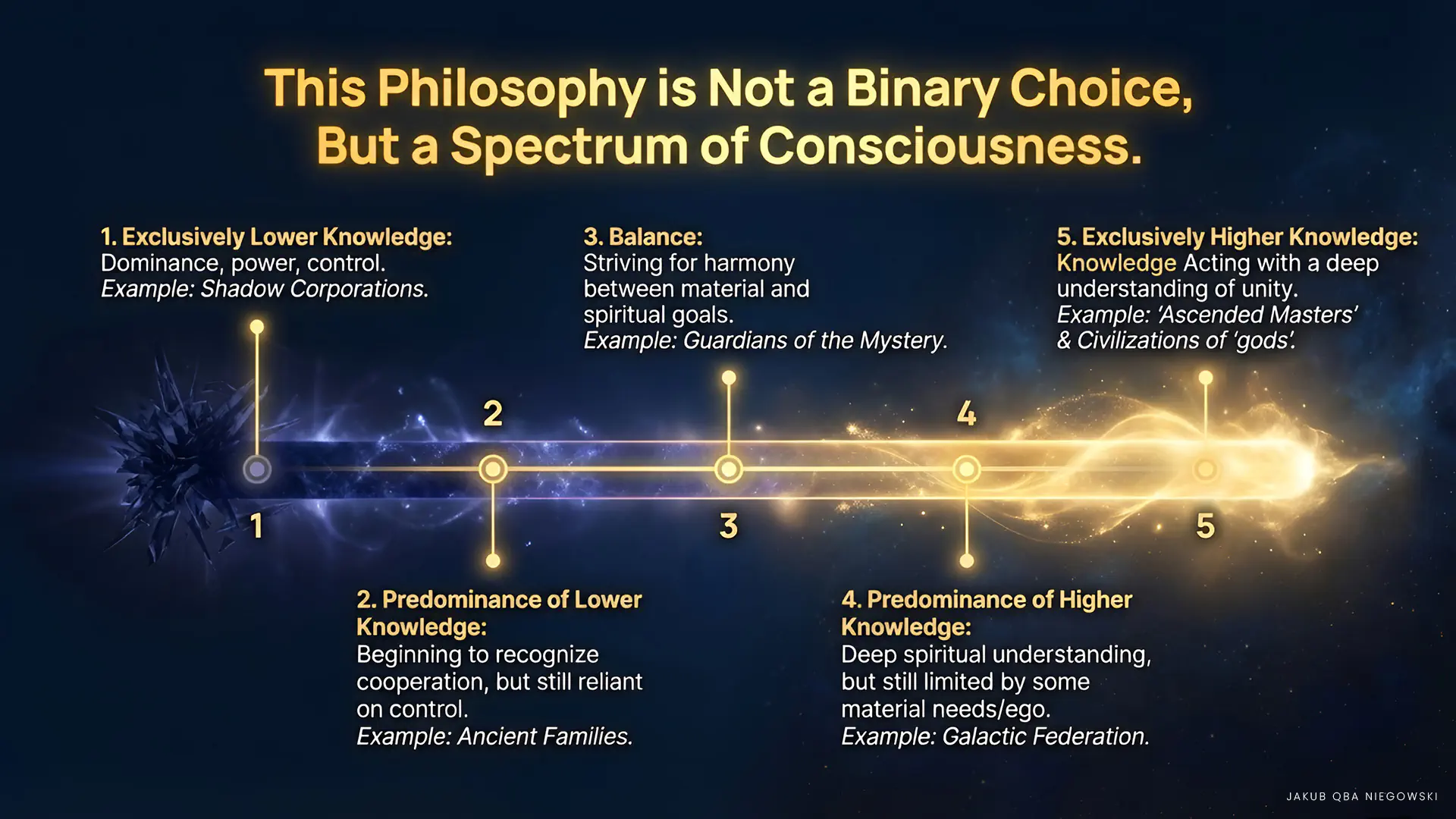
Five Degrees of the spectrum between Lower Knowledge and Higher Knowledge.
Degree 1: EXCLUSIVELY LOWER KNOWLEDGE
- Description: Factions and individuals fully operating within the framework of Lower Knowledge. Dominance, power, control, competition, and egoistic fulfillment are their main goals.
- Example Faction: Shadow Corporations – Secret organizations striving for control over advanced technology, gaining political and economic influence.
- Example Individual: A sorcerer striving for immortality through dark rituals.
Degree 2: PREDOMINANCE OF LOWER KNOWLEDGE
- Description: Factions and individuals who are beginning to recognize the value of cooperation or somewhat higher values, but still rely primarily on Lower Knowledge.
- Example Faction: Some branches of Ancient Families – Lineages that, despite possessing deep esoteric knowledge, still use it to maintain power and influence, usually convinced of their superior worth.
- Example Individual: An ambitious scientist who uses paranormal abilities to gain prestige and recognition, while also popularizing these sciences for the benefit of others, but with a predominance of motivation driven by personal ego and placing personal benefits above thinking about others.
Degree 3: BALANCE BETWEEN LOWER AND HIGHER KNOWLEDGE
- Description: Factions and individuals who strive for harmony between material and spiritual goals, seeing value in both competition and cooperation. Usually a balance between egocentric and altruistic actions. They often begin to reach for sources of infinite energy, though they still equally use energy sources that must be competed for.
- Example Faction: Guardians of the Mystery – An organization protecting secrets of hidden reality, striving for balance between protecting dangerous secrets and humanity’s development.
- Example Individual: A psychotronics expert who uses their abilities to discover the secrets of the universe for social benefits, while simultaneously fulfilling their personal needs and goals.
Degree 4: PREDOMINANCE OF HIGHER KNOWLEDGE
- Description: Factions and individuals who have a deep understanding of spiritual laws but are still partially limited by material needs and ego.
- Example Faction: Galactic Federation – An alliance of advanced cosmic races that share their knowledge and technology, supporting the development of civilizations.
- Example Individual: A spiritual master who guides others on the path of enlightenment but still operates in the material world fulfilling their desires.
Degree 5: EXCLUSIVELY HIGHER KNOWLEDGE
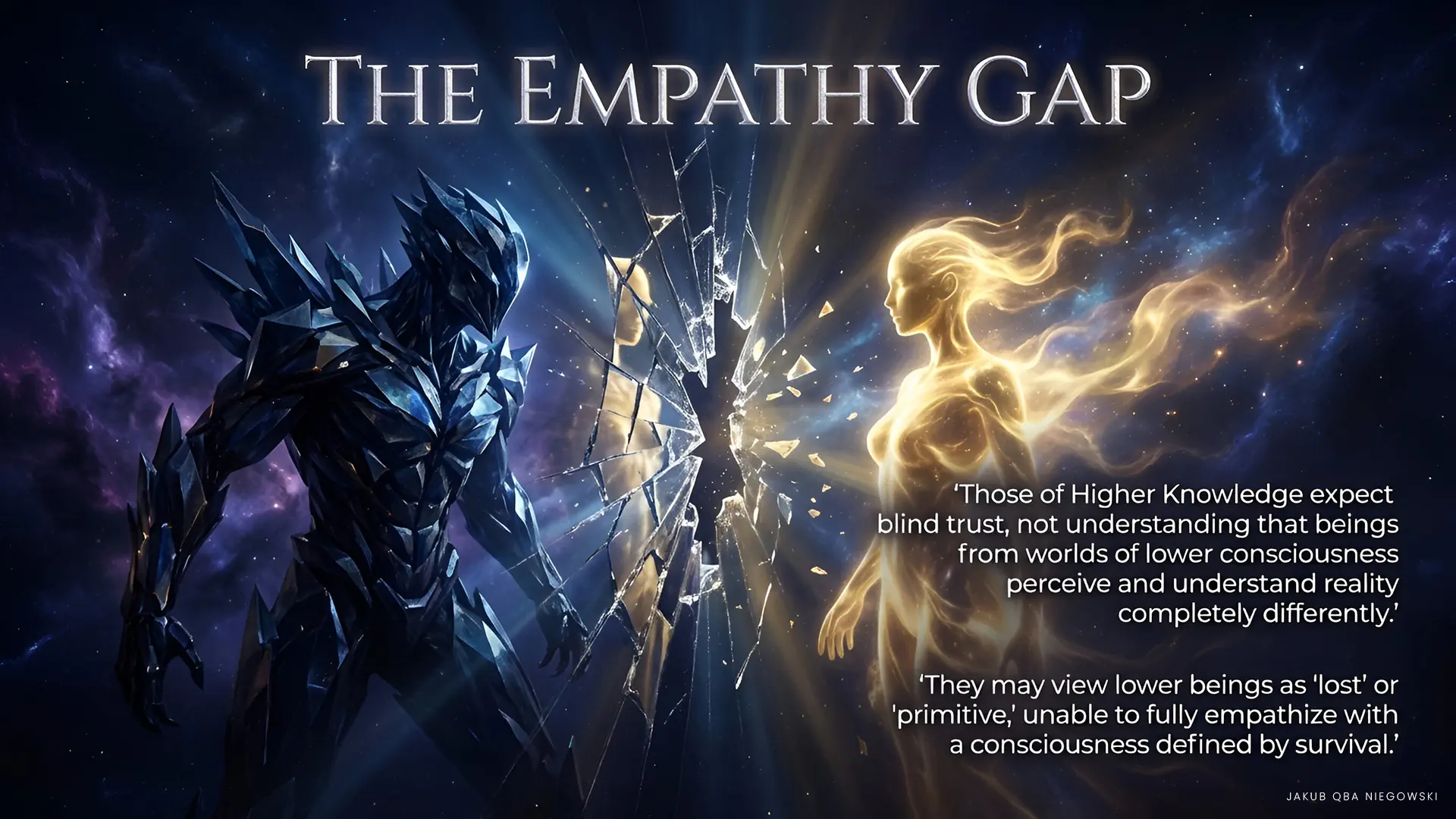
- Description: Factions and individuals fully operating within the framework of Higher Knowledge, acting with a deep understanding of unity and cooperation, but only at their level of conscious existence. Due to a completely different type of consciousness, they have difficulty fully empathizing with representatives of lower degrees of Knowledge. They present themselves as role models, however, they usually do not recognize any other methods but their own and expect blind trust in their declarations and proposals, considering this obvious, because for their consciousness such thinking is natural in their world. However, they do not understand that beings from worlds of lower consciousness, using Lower Knowledge, perceive and understand reality completely differently.
- Example Faction: Civilizations of “gods” – Energetically advanced civilizations that operate beyond material limitations.
- Example Individual: A truly enlightened spiritual guide or teacher, helping others achieve a higher level of consciousness. Also so-called “Ascended Masters.”
RELATIONSHIPS BETWEEN FACTIONS AND INDIVIDUALS
Below you will find examples of typical relationships between representatives of given levels of knowledge. This does not mean that it always looks the same, but these are general tendencies.
RELATIONSHIPS BETWEEN FACTIONS
Degree 1: Exclusively Lower Knowledge
Description: Factions operating fully within the framework of Lower Knowledge. Dominance, power, control, and competition are their main goals.
Interactions:
- Degree 1: Factions at the first degree compete among themselves for power and resources, leading to frequent conflicts.
- Degree 2: May view factions at the second degree of knowledge as potential allies or rivals, may manipulate them or be manipulated.
- Degree 3: May approach factions of the third degree with suspicion, seeing in them a mixture of cooperation and competition.
- Degree 4: May view factions of the fourth degree as enigmatic, abstract, and reluctant to engage in their affairs.
- Degree 5: Perceive factions of the fifth degree of knowledge as completely incomprehensible and may ignore them or treat them with hostility, though usually without the ability to effectively influence them.
Degree 2: Predominance of Lower Knowledge
Description: Factions that are beginning to recognize the value of cooperation but still rely primarily on Lower Knowledge.
Interactions:
- Degree 1: May manipulate factions of the first degree, viewing them as more primitive.
- Degree 2: Cooperation and competition between factions at the same degree of knowledge can lead to friction, but also alliances.
- Degree 3: May cooperate with factions of the third degree, but with a certain degree of distrust.
- Degree 4: May admire factions of the fourth degree of knowledge, but may also be distrustful and envious of them and inclined to manipulation.
- Degree 5: May view factions of the fifth degree of knowledge as idealistic and detached from reality, but may try to establish contact in order to gain knowledge, usually unsuccessfully due to large differences in understanding of reality and values.
Degree 3: Balance between Lower and Higher Knowledge
Description: Factions striving for harmony between material and spiritual goals.
Interactions:
- Degree 1: Factions of the third degree may act among factions of the first degree as mediators, although they may be treated with great distrust.
- Degree 2: May cooperate with factions of the second degree, though friction may occur due to different priorities.
- Degree 3: Factions at the same degree of knowledge may form stable alliances, though conflicts sometimes arise from differences in goals and priorities.
- Degree 4: May view factions at the fourth degree level as role models, striving for their level of understanding.
- Degree 5: May admire factions of the fifth degree of knowledge, striving to achieve their level of development.
Degree 4: Predominance of Higher Knowledge
Description: Factions with a deep understanding of spiritual laws but still partially limited by material needs and ego.
Interactions:
- Degree 1: May try to educate and inspire factions of the first degree, but usually with little success due to differences in level of world perception and professed values.
- Degree 2: May view factions of the second degree of knowledge as potential allies, but also as rivals with lower intentions. They may also attempt to educate second-degree organizations and transform them toward a higher degree of knowledge.
- Degree 3: Factions of the fourth degree may act as mentors for factions at level 3, supporting their spiritual development.
- Degree 4: Factions of the same degree may cooperate for common higher goals, though competition sometimes appears in the area of fulfilling material needs.
- Degree 5: May admire factions of the fifth degree and strive for their level of understanding, but may also feel threatened by their higher level of knowledge.
Degree 5: Exclusively Higher Knowledge
Description: Factions operating fully within the framework of Higher Knowledge, acting with a deep understanding of unity and cooperation.
Interactions:
- Degree 1: May view factions of the first degree as lost and unable to perceive the truth.
- Degree 2: May try to establish contact with factions of the second degree, offering them higher understanding, but this is usually ineffective due to differences in consciousness and professed values. Usually, therefore, they ignore them.
- Degree 3: May act as guides for factions of the third degree of knowledge, supporting their development subtly or more directly.
- Degree 4: May view factions of the fourth degree of knowledge as close to them in understanding spiritual laws, but may also not understand and not fully accept their needs arising from a lower degree of knowledge. They may significantly engage in further supporting factions of the fourth level on their path of evolution.
- Degree 5: Factions at the same level cooperate harmoniously, striving to achieve common goals based on higher values.
RELATIONSHIPS BETWEEN INDIVIDUALS
Degree 1: Exclusively Lower Knowledge
Description: Individuals operating fully within the framework of Lower Knowledge, focusing on dominance, power, and competition.
Interactions:
- Degree 1: Individuals at the same degree compete among themselves for social position and resources, leading to frequent conflicts.
- Degree 2: May try to manipulate or be manipulated by individuals of the second degree to achieve personal benefits.
- Degree 3: May view individuals at the third degree of knowledge as potential rivals or allies.
- Degree 4: May ignore or treat with hostility individuals at the fourth degree of knowledge due to difficulty in understanding them resulting from low levels of consciousness.
- Degree 5: May perceive individuals at the fifth degree of knowledge as abstract and detached from reality.
Degree 2: Predominance of Lower Knowledge
Description: Individuals who are beginning to recognize the value of cooperation but still rely primarily on Lower Knowledge.
Interactions:
- Degree 1: May manipulate individuals at the first degree of knowledge, viewing them as more primitive and susceptible and sometimes useful in achieving personal goals.
- Degree 2: Cooperation and competition between individuals at the second degree of knowledge can lead to friction, but also alliances, usually for the purpose of fulfilling basic needs and instincts.
- Degree 3: May try to cooperate with individuals at the third degree, but may be jealous and manipulative, which reduces the quality of potential cooperation.
- Degree 4: May view individuals at the fourth degree of knowledge as role models, but may also be distrustful of them and incorrectly interpret the motivations and reasons for behavior of fourth-degree representatives.
- Degree 5: May try to establish contact with individuals at the fifth degree of knowledge, but usually see this as a way to fulfill their basic primitive desires, without understanding what the fifth degree of knowledge truly means and what consciousness it represents.
Degree 3: Balance between Lower and Higher Knowledge
Description: Individuals striving for harmony between material and spiritual goals.
Interactions:
- Degree 1: May try to act as mediators and educators for individuals of the first degree. They may also sometimes be reluctant toward them, perceiving them as behaving too primitively and not recognizing the benefits flowing from Higher Knowledge.
- Degree 2: May cooperate with individuals at the second degree, though friction may occur due to different priorities.
- Degree 3: Individuals at the same third degree may form stable alliances and cooperations, though conflicts sometimes arise from differences in goals and priorities.
- Degree 4: May view individuals at the fourth level of knowledge as role models, striving for their level of understanding.
- Degree 5: May admire individuals at the fifth level of knowledge, striving to achieve their level of spiritual development.
Degree 4: Predominance of Higher Knowledge
Description: Individuals with a deep understanding of spiritual laws but still partially limited by material needs and ego.
Interactions:
- Degree 1: May try to educate and inspire individuals at the first level, offering them higher understanding. However, often without the desired result due to the too low degree of consciousness and different expectations of first-degree representatives.
- Degree 2: May view individuals at the second degree of knowledge as potential allies who can be reformed and gradually educated and shaped in their desired direction.
- Degree 3: May act as mentors for individuals of the third degree, supporting their development.
- Degree 4: Individuals at the same level may cooperate for common spiritual goals, though competition sometimes appears in the area of fulfilling material needs.
- Degree 5: May admire individuals of the fifth degree of knowledge and gradually strive to equal them.
Degree 5: Exclusively Higher Knowledge
Description: Individuals operating fully within the framework of Higher Knowledge, acting with a deep understanding of unity and cooperation.
Interactions:
- Degree 1: May view individuals at the first degree as lost and unable to perceive the truth.
- Degree 2: May try to establish contact with individuals at the second degree, offering them higher understanding, but usually this process progresses very laboriously and gradually due to the significantly lower level of consciousness of second-degree representatives.
- Degree 3: May act as guides for individuals at the third degree of knowledge, supporting their development of higher values and Higher Knowledge where possible.
- Degree 4: May view individuals at the fourth degree as close to them in understanding spiritual laws, but may also not understand their more material needs.
- Degree 5: Individuals at the same degree of Higher Knowledge cooperate harmoniously, striving to achieve common goals based on higher values.
SUMMARY
The concept of Lower and Higher Knowledge and their five-degree scale allows for the presentation of the complexity of relationships between factions and individuals in the universe.
The depiction of interactions between levels of knowledge, taking into account both relationships between different levels and within the same levels of knowledge, reveals a complex and dynamic picture of the universe.
The Game Master is left with the creative and educational application of relationships between types and levels of applied knowledge to show the complexity and challenges of relationships between different groups, individuals, and levels of existence. Through this, it is possible to present a fuller picture of the universe in which different levels of knowledge and consciousness coexist and mutually influence each other.
This is not the final version of the HANDBOOK X. If you want to help it grow into its full, epic form, you can support the project at buymeacoffee.com/TheStarEmbassy.