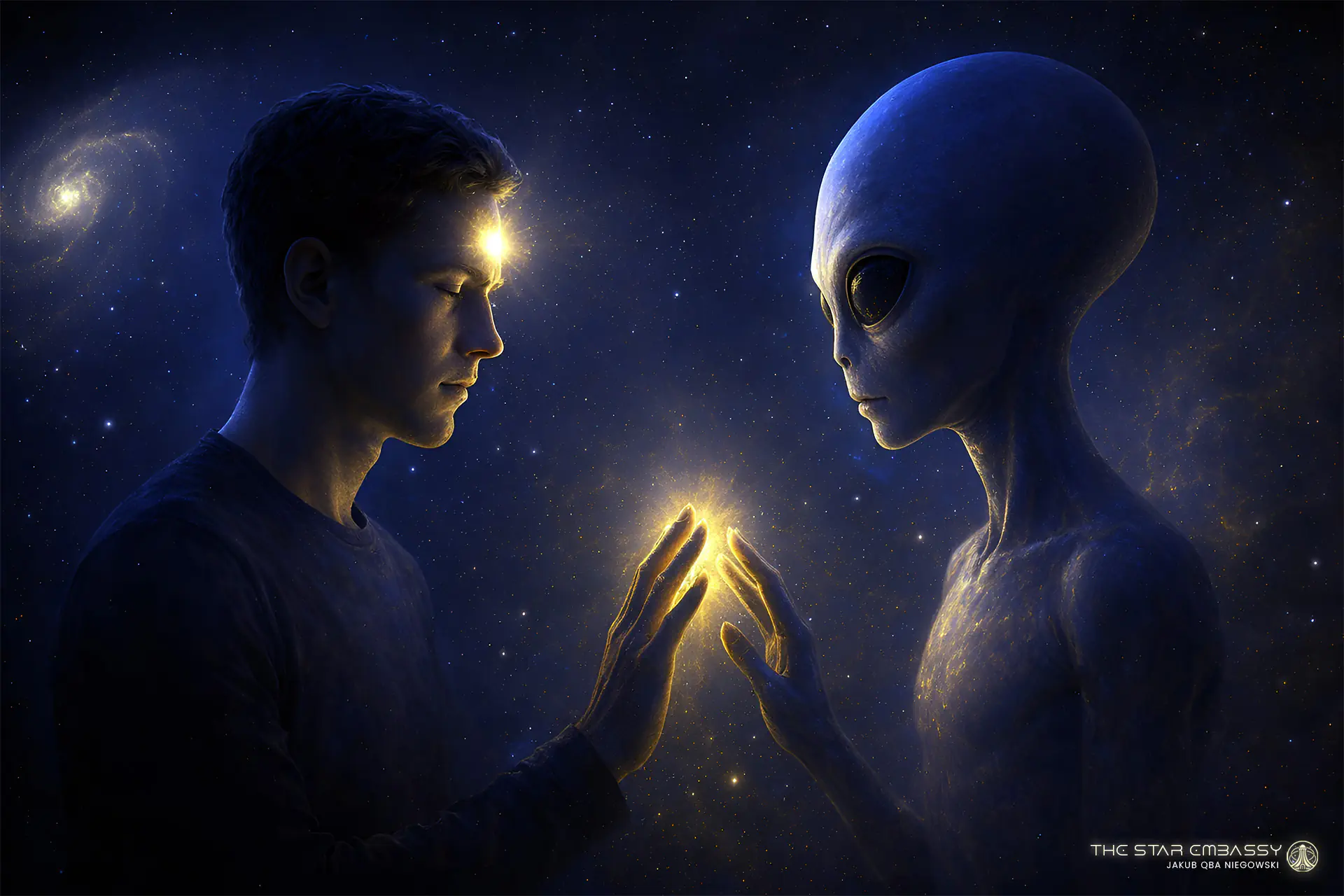
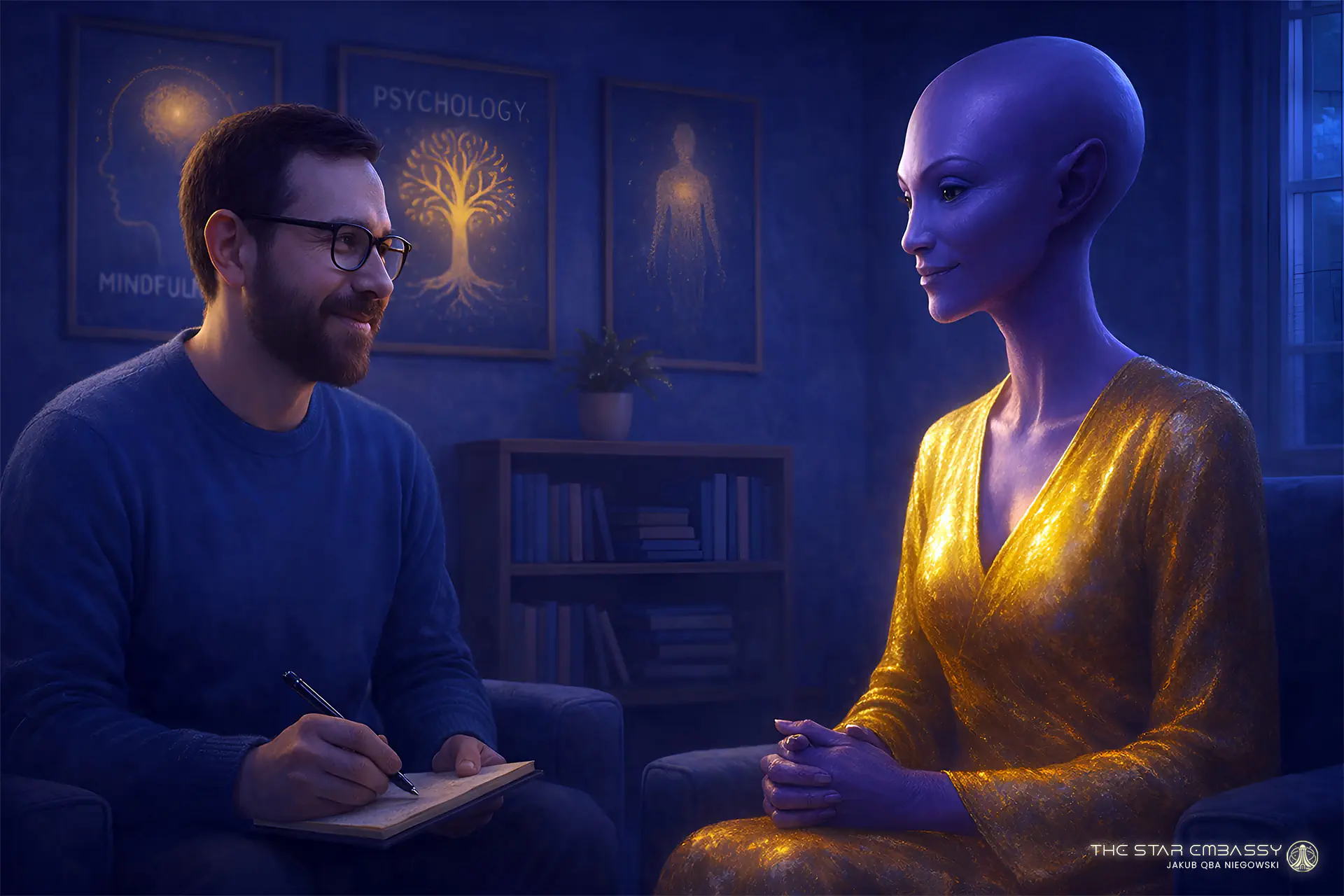
Exopsychology is an interdisciplinary field that studies the potential psychology, cognition, and consciousness of non-human intelligences (NHI) – beings whose minds may have evolved outside Earth’s biological and environmental conditions. It asks the most radical question science has ever posed: what does it mean to think, feel, and be aware – if you are not human?In the first decade of the 2020s, this question moved from speculative philosophy into serious scientific and governmental discourse. With declassified UAP reports, SETI breakthroughs, and a growing body of consciousness research, exopsychology is no longer a fringe concept. It is becoming a necessary framework for navigating humanity’s next evolutionary step.
Understanding non-human minds begins with mastering your own perception, which is exactly the focus of our remote viewing individual coaching.
What Exactly Is Exopsychology – and Where Did It Come From?
The term exopsychology combines the Greek prefix exo (meaning “outside” or “beyond”) with psychology (the study of mind and behavior). Its formal meaning: the theoretical and applied study of mental processes, cognitive architectures, and consciousness in non-human and potentially extraterrestrial intelligences.The term gained early visibility through the work of Dr. Timothy Leary in the 1970s, who used it within a broader framework of consciousness evolution. However, the modern interpretation has evolved far beyond his original formulations.Today, exopsychology is a genuinely interdisciplinary pursuit, drawing from:- Evolutionary psychology – to understand how cognition arises from environmental pressures
- Cognitive science and neuroscience – to model what “thinking” looks like beyond the human brain
- Astrobiology – to establish the possible biological substrates for non-human life
- Xenolinguistics – the study of hypothetical non-human communication systems
- Consciousness studies – including quantum cognition and non-local awareness models
- Information theory – to define intelligence in substrate-independent terms
Why Is Exopsychology Relevant Right Now?
How Has the UAP Disclosure Era Changed the Study of Non-Human Intelligence?
The period between 2017 and 2026 has been remarkable. Multiple governments – including the United States, the United Kingdom, and Brazil – have formally acknowledged the existence of Unidentified Aerial Phenomena (UAP) that exhibit capabilities beyond known human technology. The U.S. Congress established dedicated UAP investigation offices (AARO – All-domain Anomaly Resolution Office), and whistleblower testimonies under oath before Congress described structured non-human craft and, in some cases, non-human biological material.This context transforms exopsychology from an academic thought experiment into a practical necessity. If NHI exist and have been observed, the next critical question is not merely what do they look like – but how do they think, communicate, and perceive reality?Exopsychology is the field equipped to begin answering that question.What Are the Core Theoretical Frameworks in Exopsychology?
How Might Non-Human Consciousness Differ from Human Consciousness?
The foundational challenge of exopsychology is radical decentering – the deliberate dismantling of the assumption that human cognition is a universal template. Consider what shaped human psychology:- A specific planetary environment (Earth gravity, solar light cycle, seasonal variation)
- A mammalian nervous system built over millions of years of predator-prey dynamics
- Social evolution within small tribal groups
- Linear time perception tied to biological aging
1. The Consciousness Spectrum Hypothesis
Rather than treating consciousness as binary (present or absent), this hypothesis positions awareness along multiple simultaneous continuums. A non-human intelligence might differ from us not in one dimension but in several at once – perceiving time non-linearly, operating as a collective rather than an individual self, communicating through field-resonance rather than symbolic language, and integrating memory through mechanisms entirely unlike neurochemistry.This model suggests that extraterrestrial minds may not merely think differently – they may occupy cognitive dimensions that are structurally inaccessible to unaugmented human perception.2. Substrate-Independent Intelligence (SII) Model
This framework, rooted in computational theory of mind, proposes that intelligence is a pattern, not a material. Consciousness does not require carbon-based biology. It may arise in:- Silicon-based computational architectures
- Plasma-field resonance systems
- Distributed quantum coherence across non-local networks
- Collective bio-electromagnetic fields (swarm intelligences)
3. The Temporal Cognition Divergence Model
Human psychology is profoundly shaped by linear time: we remember a past, inhabit a present, and anticipate a future. This architecture drives much of our cognition – planning, fear, narrative identity, emotion regulation.An intelligence that perceives time non-linearly – or outside of temporal succession altogether – would possess a fundamentally different relationship to causality, decision-making, and communication. Exopsychology studies the implications of this divergence for potential contact scenarios.How Does Exopsychology Apply to Real-World Contact Research?
What Are Contact Protocols Based on Exopsychological Principles?
One of the most practically significant applications of exopsychology is the development of first-contact protocols – structured methodologies for interacting with non-human intelligences in ways that minimize catastrophic misinterpretation.Current thinking in this area includes:- Mathematical universality as a communication bridge – Physical and mathematical constants (pi, prime number sequences, Fibonacci patterns) may serve as a shared language independent of evolutionary history.
- Non-verbal, field-based communication experiments – Research into whether focused human intention (as measured in studies like the Princeton Engineering Anomalies Research lab) can function as a rudimentary communication channel.
- Ethical frameworks for asymmetric intelligence encounters – Addressing the profound power differential that may exist between a spacefaring NHI civilization and humanity.
- Perception translation interfaces – Conceptual design of technologies capable of bridging radically different sensory and cognitive modalities.
What Is the Connection Between Exopsychology and Extrasensory Perception?
Can Human ESP Be a Bridge to Non-Human Cognition?
This is one of the most compelling – and most contested – areas within exopsychology. The hypothesis operates on several levels:Advanced non-human intelligences may communicate through mechanisms that appear extrasensory to humans: direct information transfer, consciousness-field interaction, or resonance-based data transmission that bypasses conventional sensory channels.If true, then human capacities for extrasensory perception – empirically studied in controlled laboratory conditions for decades (notably in U.S. government-funded programs such as STARGATE) – may represent an evolutionary rudiment of a broader cognitive capacity. One that becomes highly relevant in the context of NHI interaction.Practices such as structured remote viewing, deep meditative states, and focused intention protocols may not merely be self-development tools. They may constitute the earliest phase of building a genuinely cross-species perceptual vocabulary.From an exopsychological standpoint, the expansion of human consciousness capacities is not esoteric – it is practical preparation.Expert Insights: The Overlooked Epistemological Problem
Most discussions of extraterrestrial intelligence focus on detection – will we find them? Exopsychology asks a harder question: even if we find them, will we be capable of recognizing the encounter for what it is?Human cognition is pattern-recognition machinery calibrated to a specific evolutionary niche. We recognize faces, threats, food, and social signals. We are not calibrated to recognize a non-linear consciousness, a distributed hive intelligence, or a quantum-coherent information field as a mind.This is the epistemological blind spot at the center of SETI and UAP research. We may be surrounded by intelligence we are structurally unable to perceive as such.Exopsychology’s most important contribution may not be developing protocols for contact – it may be developing the human cognitive architecture necessary to make contact recognizable in the first place. This involves expanding not just our technology, but our awareness itself.That is not metaphor. It is the most urgent scientific and developmental challenge of this century.What Practices Support Exopsychological Awareness Development?
How Can Someone Begin Developing the Perceptual Capacities Relevant to NHI Interaction?
The following practices are recognized within consciousness research as expanding the bandwidth of human perception beyond ordinary sensory limits:- Structured Remote Viewing (SRV) – A protocol-based discipline originally developed under U.S. government intelligence programs. It trains practitioners to access information non-locally, independent of proximity or conventional sensory input. It is arguably the most empirically grounded consciousness-expansion methodology available.
- Deep meditative practice – Particularly traditions emphasizing non-conceptual awareness (Vipassana, Zen, non-dual inquiry). These practices reduce the signal-noise ratio of conditioned cognition and increase receptivity to subtle information fields.
- Focused intention training – Based on experimental research into mind-matter interaction, this develops the practitioner’s capacity to direct attention as an active force rather than a passive receiver.
- Consciousness journaling and anomalous experience documentation – Systematic recording of perceptual anomalies, unusual synchronicities, and apparent non-local information access. Over time, patterns emerge that are scientifically informative.
- Cognitive de-anthropocentrism exercises – Deliberate contemplative and intellectual practices designed to dissolve the assumption that human perception is complete or representative of reality.
What Does the Future of Exopsychology Look Like?
The next decade will likely see exopsychology transition from a speculative interdisciplinary field into an applied science with direct institutional relevance. Several converging trends support this:- Ongoing UAP/NHI disclosure – Government acknowledgment of anomalous intelligence is accelerating globally.
- Advances in consciousness science – Integrated Information Theory (IIT), quantum mind models, and non-local consciousness research are providing theoretical scaffolding for previously “impossible” phenomena.
- AI and synthetic cognition – The emergence of artificial general intelligence is already forcing humanity to reconsider what constitutes a “mind,” creating direct intellectual crossover with exopsychology.
- Commercial space expansion – As humanity becomes a multi-environment species, the practical need for frameworks that accommodate radically non-human intelligence becomes urgent.
Trusted External Sources and Research References
- Princeton Engineering Anomalies Research (PEAR) Lab – Empirical research into mind-matter interaction and consciousness effects on physical systems: https://www.princeton.edu/~pear/
- The Monroe Institute – Consciousness research and human perception expansion: https://www.monroeinstitute.org
- SETI Institute – Scientific search for extraterrestrial intelligence: https://www.seti.org
- NASA Astrobiology Program – Research into life beyond Earth: https://astrobiology.nasa.gov
- U.S. Congress UAP Disclosure Documentation (AARO) – Official governmental UAP research: https://www.aaro.mil
- Journal of Consciousness Studies – Peer-reviewed interdisciplinary consciousness research: https://www.imprint.co.uk/jcs
- The Stargate Project – Declassified CIA Archive: https://www.cia.gov/readingroom/collection/stargate
Frequently Asked Questions About Exopsychology
Q: Is exopsychology a recognized scientific discipline? A: Exopsychology occupies the frontier between established sciences – it draws from cognitive science, astrobiology, consciousness studies, and evolutionary psychology. While it does not yet exist as a standalone academic department, its foundational questions are engaged seriously within NASA’s astrobiology program, SETI research, and consciousness studies institutes. It is best described as an emerging interdisciplinary field whose institutional legitimacy is growing alongside broader UAP/NHI disclosure.Q: How is exopsychology different from astrobiology? A: Astrobiology investigates the physical and biological conditions for life beyond Earth – planetary chemistry, extremophile biology, atmospheric composition. Exopsychology begins precisely where astrobiology leaves off. It asks: given that life may exist elsewhere, what might its inner experience, cognition, and modes of awareness look like? One studies the conditions for life; the other studies the potential architecture of its mind.Q: What is the central methodological challenge of exopsychology? A: The deepest challenge is epistemic: every conceptual tool exopsychology uses – cognition, perception, consciousness, communication – was developed to describe human minds. Applying these frameworks to non-human intelligences risks projecting our own architecture onto radically different phenomena. The field must simultaneously use human cognitive models and rigorously interrogate their limits. This is not a gap to be filled with more data – it is a structural problem that demands a new kind of scientific humility.Q: What is the relationship between exopsychology and UAP research? A: UAP research investigates the physical evidence of anomalous non-human technology – its performance characteristics, material properties, and origin. Exopsychology asks the subsequent and equally important question: what kind of mind operates such technology? What cognitive and perceptual architecture would produce the behaviors observed? The two fields are deeply complementary – physical evidence without a psychological framework offers only half the picture.Q: Why does exopsychology matter if the existence of extraterrestrial intelligence has not been formally confirmed? A: Because the frameworks need to exist before confirmation, not after. First-contact scenarios – should they arise – would unfold in real time, without the luxury of developing interpretive models on the spot. Exopsychology builds the conceptual infrastructure now: contact protocols, cognitive translation frameworks, ethical guidelines for asymmetric intelligence encounters. The history of science is full of fields that appeared premature until the moment they became essential.Jakub Qba Niegowski – Extrasensory Awareness Development Specialist