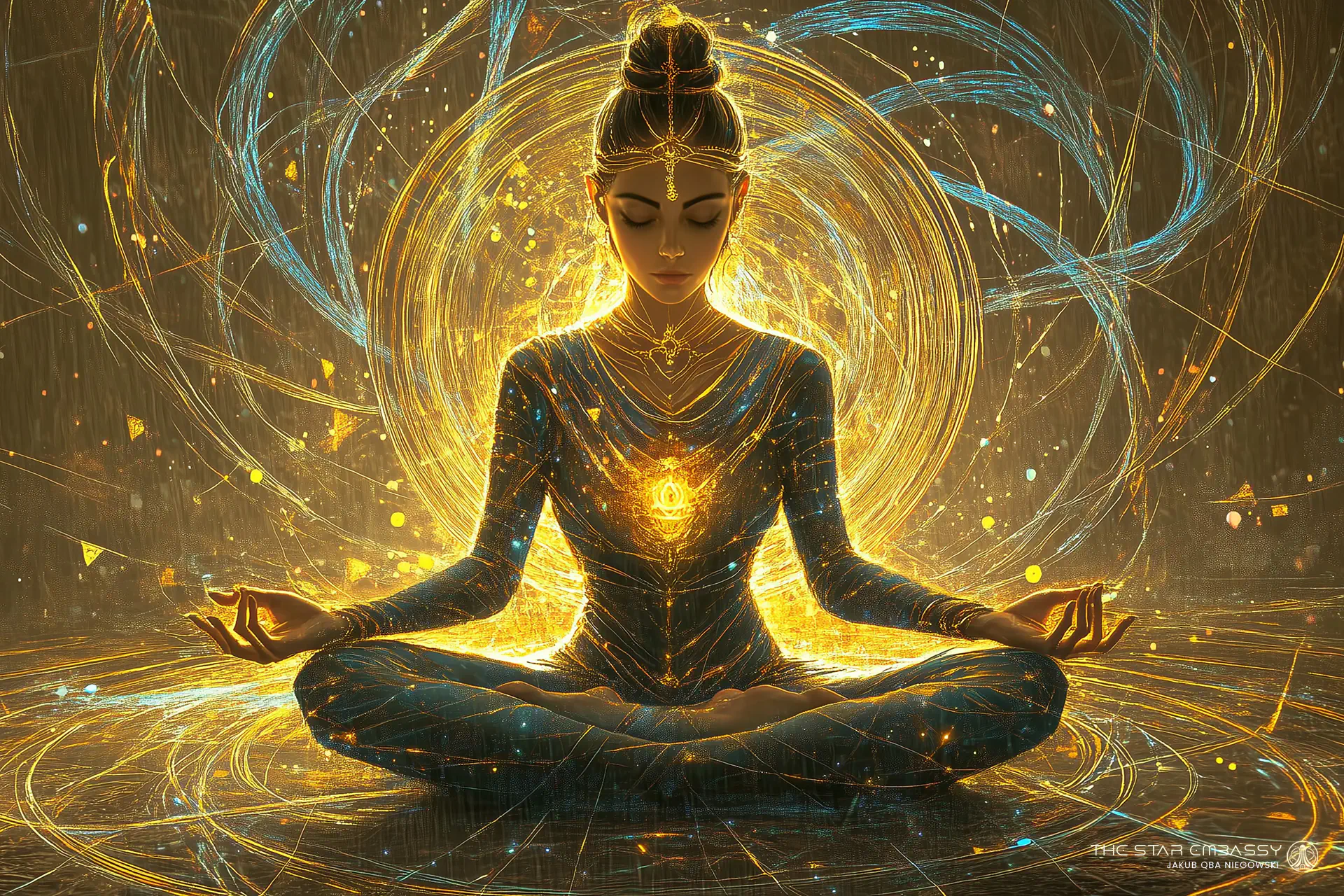
Meditation is the practice of consciously directing attention and intention inward – to quiet the mind, restore energy, and elevate the quality of existence on both physical and spiritual levels. You can begin today, at home, with no accessories or prior experience. All it takes is a few minutes, a quiet space, and the willingness to stop.
Below you’ll find four specific meditation techniques – from simple relaxation to chakra work and mantra practice – that together form a solid, multi-dimensional foundation for your practice.
Why It’s So Hard to Find Peace Today – and What Meditation Does About It
We live in an environment that bombards the mind with stimuli on a scale unmatched by any previous moment in history. Notifications, news, pressure, an overwhelming number of choices – the mind is overloaded, and the body carries accumulated tension we often don’t even feel.
The result? Chronic fatigue, irritability, difficulty concentrating, and a sense of disconnection from yourself.
Meditation isn’t just another relaxation method. It’s a systematic training of the ability to dwell within yourself – with calm, mindfulness, and intention. From the perspective of spiritual development, it’s irreplaceable: a person who is inwardly chaotic has no stable ground from which to grow.
What Is Meditation – The Definition You’re Looking For
Meditation (from the Latin meditatio – deep reflection, contemplation) is the practice of directing focused attention to a chosen inner object – breath, visualization, mantra, or energy center – in order to reach a deeper state of awareness, peace, and inner harmony.
Unlike passive rest, meditation is an active mental act directed inward. The goal isn’t to “turn off thoughts” – it’s to change your relationship with them.
Quick Comparison: Effects of Each Technique
| Meditation Technique | Primary Effect | Difficulty for Beginners |
|---|---|---|
| Technique 1: Relaxation Meditation | Releasing tension, emotional calm | Very low |
| Technique 2: Concentration and Visualization | Better attention, mental sharpness | Low-Medium |
| Technique 3: Chakra Meditation | Energetic balance, vitality | Medium |
| Technique 4: Mantra Meditation | Deeper state of awareness, inner silence | Low-Medium |
What You Need to Start Meditating at Home
Less than you think.
A quiet place – somewhere no one will walk in for at least fifteen minutes. A comfortable position – lying down or seated, with your spine reasonably upright. Lotus pose is not required. Time – even 10-15 minutes is enough to feel a real effect. Consistency – one session shifts your mood. Regular practice shifts your life.
That’s truly all. Meditation isn’t the domain of monks or the enlightened. It’s a tool available to everyone.
4 Meditation Techniques – How to Practice Each One
Technique 1: Relaxation Meditation – How to Release Tension and Restore Energy
Relaxation is the foundation of all other techniques. Before the mind is ready for deeper work, the body must be freed from accumulated tension – physical and emotional. Piled-up stress acts like noise interfering with your inner signal.
I use two complementary approaches here – energetic and somatic.
Variant A: Energetic Relaxation Meditation
The goal is to release burdening emotions and recharge with fresh energy.
Lie comfortably on your back, arms at your sides, spine straight. Place something small under your head if needed. Begin breathing calmly and evenly – at a rhythm that feels natural and pleasant to you. With each exhale, visualize what is heavy leaving the body: irritation, sadness, fear, tension. Imagine it departing like smoke or dark fog. With each inhale, visualize white, luminous energy flowing in – bringing calm, blissful relaxation, and strength. Repeat this cycle until you feel a real shift in how you feel.
Note: visualization doesn’t have to mean seeing images. A sense of intention or inner feeling works just as well.
Variant B: Body Relaxation Meditation
The goal is conscious relaxation of all muscle groups – especially those we habitually tense without realizing it.
Lie down comfortably. Close your eyes. Count slowly from 1 to 6, assigning each number to a specific body part:
- 1 – Gently move the muscles of your face, then let them fall completely and relax.
- 2 – Move the muscles of your neck, find its most comfortable position, and let it fully relax.
- 3 – Take a deep breath, lifting the diaphragm, then release the air freely – simultaneously relaxing the entire torso.
- 4 – Move your arms, gently tense them, then let them drop and fully relax.
- 5 – Do the same with your legs – tense the muscles, then release them completely.
- 6 – Bring your attention to the whole body and deepen the overall relaxation.
Count slowly. Don’t rush. Wait for each area to truly let go before moving on. With regular practice, simply saying a given number will automatically trigger relaxation in the corresponding muscles – it’s a matter of training.
Duration: 10-20 minutes. When to use: before any other meditation technique, or on its own after a difficult day.
Technique 2: Concentration and Visualization Meditation – How to Train Your Mind
Concentration and visualization are two key abilities in any mental work – and they can be trained simultaneously in a surprisingly simple way. The strength of these two functions directly affects the quality of all other techniques, as well as everyday intellectual performance.
Sit or lie down comfortably. Close your eyes. Choose any fruit in your imagination – an apple, an orange, a lemon. You don’t need a physical object. The fruit exists only in your mind. Begin to visualize it intensely. Imagine its shape, color, and texture. Smell it. Taste it. Make it as real as possible to your inner senses. Hold this visualization for the entire session. When your thoughts start to wander – and they will; it’s inevitable – simply notice it calmly and return to the fruit. No frustration, no self-judgment. The moment of returning is itself the exercise.
What seems simple turns out to be a real challenge for most people in the first sessions. The mind is accustomed to wandering. That’s precisely why this exercise works.
Duration: 10-15 minutes. When to use: daily or several times a week – results become visible after a few weeks of regular practice.
Technique 3: Chakra Meditation – How to Work with Your Body’s Energy
Chakras are energy centers in the subtle body, responsible for the flow and regulation of life force. Their harmonious functioning influences both health and well-being, as well as perceptual and spiritual abilities.
Note: People with epilepsy, serious heart conditions, or acute mental health disorders are advised to consult a specialist before beginning this practice.
Variant A: White Energy Meditation
Lie comfortably on your back, arms at your sides. Begin to visualize white, luminous energy entering the root chakra (located between the genitals and the anus). Feel this center beginning to fill and grow stronger. Gradually direct the energy upward – to each subsequent chakra in order:
- Sacral chakra (about 3 cm below the navel)
- Solar plexus (upper abdomen area)
- Heart chakra (center of the chest)
- Throat chakra (center of the neck)
- Third eye (center of the forehead, at eyebrow level)
- Crown chakra (the entire top of the head)
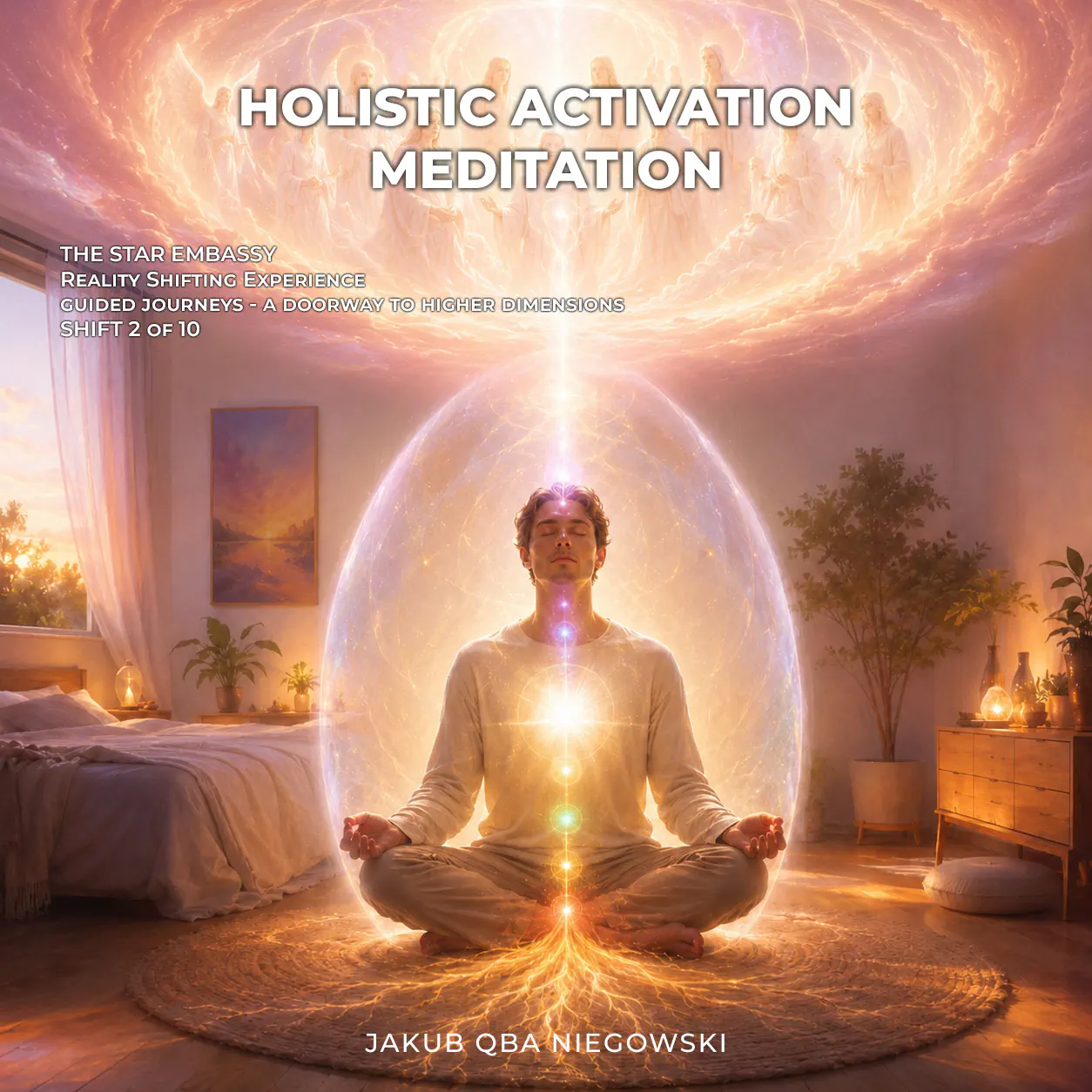
Guide the energy sequentially – as you move your attention upward, remember that the energy continues flowing through all previous centers. Once all chakras are charged, allow the excess energy to exit through the crown, gently envelop the entire body like a luminous egg, then return through the root chakra – creating a closed, regenerative circuit.
Duration: 15-20 minutes.
Variant B: Color Chakra Meditation
Lie comfortably in the same way. Begin at the root chakra – visualize a red column of light flowing down from above and filling that center. Without interrupting the visualization of the red light, add another stream – orange – directed at the sacral chakra. Continue adding streams for each subsequent chakra: solar plexus – yellow; heart chakra – green or pink; throat chakra – blue; third eye – violet; crown chakra – white. Hold the visualization of all colors simultaneously for as long as possible – up to 30 minutes maximum.
At first it’s hard to keep all the colors in mind at once – start with two or three chakras and gradually expand your range as your visualization skills grow.
Duration: 15-30 minutes.
Technique 4: Mantra Meditation – How to Use Sound to Shift Your State of Consciousness
A mantra is a sound that carries a specific vibration – and that vibration works whether the mantra is spoken aloud or only repeated in the mind. It doesn’t need to be understood or translated to have an effect – its power lies in the structure of the sound, not the meaning of the words. An additional benefit is automatic concentration training: a mind engaged in rhythmically repeating a mantra has less room for chaotic thoughts.
Lie down comfortably or sit with your spine upright – the key is that your position supports relaxation. Close your eyes and simply observe your breath for a moment – let it become even and natural. Once your breath has settled, begin synchronizing the mantra with it:
- Inhale → silently vibrate OM
- Pause (between inhale and exhale) → TAT
- Exhale → SAT
Adjust the length of each sound to your natural breathing pace – the mantra should become an integral part of your breath, not something imposed on it. When thoughts interrupt the mantra, calmly return to it – without rushing, without judgment. At some point the mantra may begin to fade – growing quieter, more subtle, almost transparent. Don’t force your way back to it. That point is the gateway to deep inner silence. Gently end the session and slowly return to everyday awareness.
Duration: 15-20 minutes. For whom: for everyone – especially people who struggle with “pure” visualization, because the rhythm of sound naturally anchors attention.
What Popular Health Guides Won’t Tell You About Meditation
Most articles about meditation focus on stress reduction and better sleep – and those are real effects. But meditation in the context of developing extrasensory awareness operates at an entirely different depth.
First: the energy body is real and responds to intentional work. The relaxation techniques described above aren’t just metaphors – they clear genuine energetic contamination that accumulates in a person’s field under the influence of stress, negative emotions, and chaotic environments. Regular practice works like energetic hygiene.
Second: visualization isn’t “imagination for fun.” It’s the directing of inner intention, which genuinely organizes energy. A mind trained in holding a precise image becomes more effective in every area – from everyday decisions to advanced extrasensory perception techniques.
Third: mantra doesn’t work through the meaning of words, but through vibration. This is why Sanskrit mantras retain their power even for people who don’t understand the language – their strength lies in the structure of sound, not in translation.
Fourth: consistency matters more than session length. Ten minutes every day for a month produces deeper results than an hour once a week. The mind and energy system learn to “enter the state” more quickly when they have a steady rhythm.
Meditation isn’t a pill for a hard day. It’s long-term training in the quality of existence – one that delivers increasingly deeper results with each passing week.
Scientific Research and Credible Sources on Meditation
- Harvard Medical School – research on meditation’s impact on brain neuroplasticity: health.harvard.edu
- National Institutes of Health (NIH) – meta-analysis of meditation’s effectiveness in reducing stress and anxiety: ncbi.nlm.nih.gov
- American Psychological Association – review of research on mindfulness and mental health: apa.org
- Jon Kabat-Zinn, Full Catastrophe Living – the scientific foundation of the MBSR (Mindfulness-Based Stress Reduction) program, one of the most thoroughly studied meditation programs in the world.
FAQ – Frequently Asked Questions About Meditation
How long does it take to feel the effects of meditation? The first effects – better mood, calm, relief from tension – can appear after just one session. Lasting changes in the quality of your mind, energy, and concentration require regular practice for at least a few weeks. Starting with 10-15 minutes per day, most people notice a clear difference after one month.
Do I have to sit in lotus pose to meditate? No. Lotus pose is not a requirement for meditation. What matters is that your spine is reasonably upright, your body is comfortable, and no part of you is compressed or tense. A lying-down position is equally effective – as long as it doesn’t lead to falling asleep.
What should I do when I can’t stop thinking during meditation? Racing thoughts are something everyone experiences – especially at first. Meditation isn’t about eliminating thoughts; it’s about changing your relationship with them: noticing that they’ve appeared, and calmly returning to your object of focus – breath, mantra, or visualization. That ability to “return” is precisely the muscle you’re training.
Which meditation technique is best for someone who has never meditated before? The best starting point is relaxation meditation – particularly the body relaxation technique. It’s simple, requires no prior skill, and its effects are almost immediate. After mastering relaxation, a natural next step is concentration and visualization meditation.
Can you combine multiple techniques in one session? Yes – and it’s actually recommended. The optimal structure for a single session is: body relaxation as the opening (5-10 minutes), followed by your chosen main technique – visualization, chakras, or mantra.
Jakub Qba Niegowski – Extrasensory Awareness Development Specialist
To experience this directly, explore our guided meditation recordings.