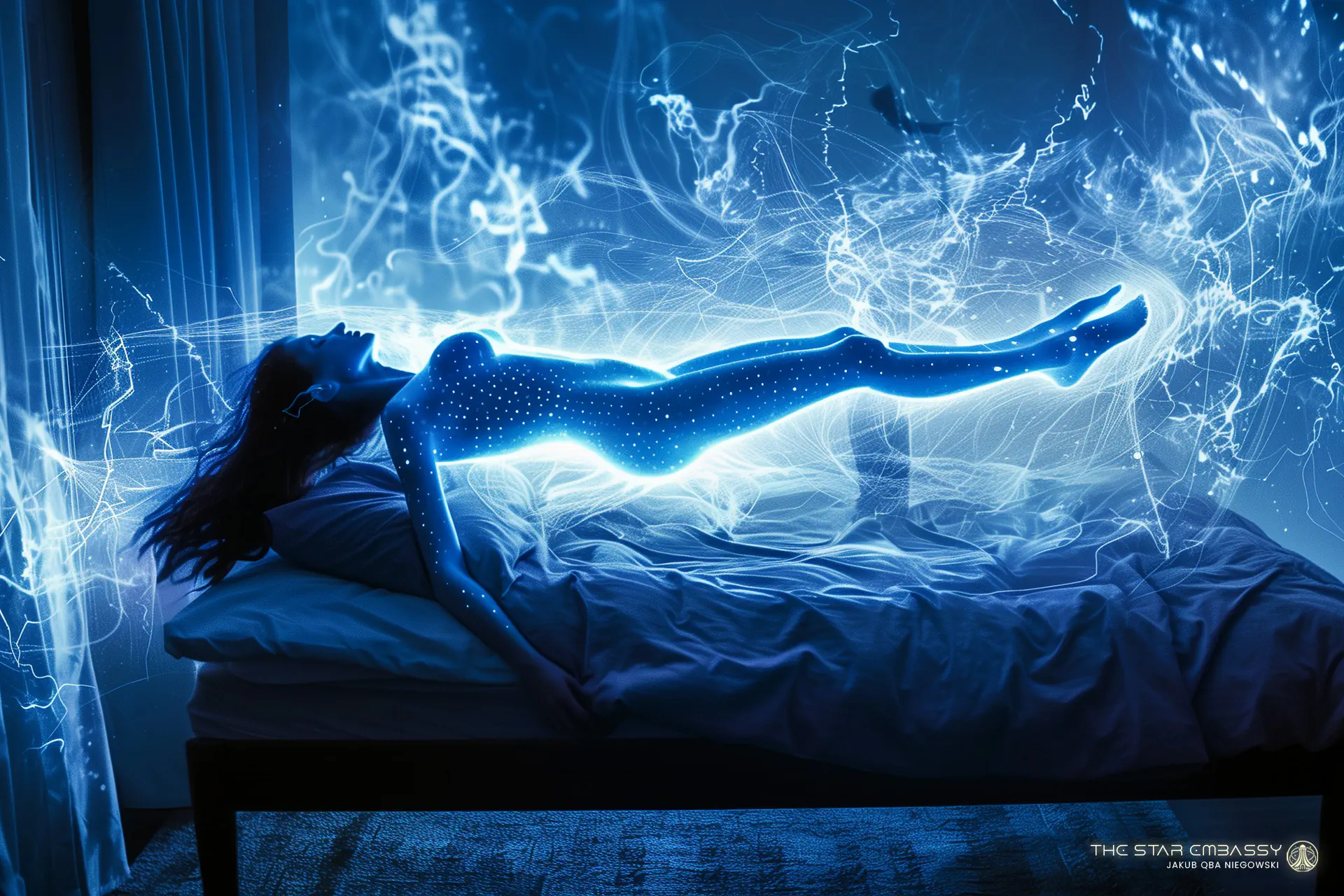
OOBE (Out-of-Body Experience) – the experience of consciousness residing outside the physical body – operates by completely different rules than anything we know from everyday material reality. For many practitioners, the greatest challenge isn’t leaving the body itself – it’s what happens afterward: uncontrolled movement, disorienting speed, and the feeling that the experience has slipped beyond the reach of one’s own will. Understanding the mechanism behind this is the first and most important step toward regaining conscious control over the out-of-body journey.
Why Do You Lose Control During OOBE?
When you first transfer your consciousness to the astral body – the non-physical counterpart of the material body – you encounter a phenomenon that catches the vast majority of practitioners completely off guard.
In the physical world, there is a clear gap between thought and action. First you want to move, then you make a decision, then the body executes it. Three separate stages, each taking its own time.
In the astral body, that division simply doesn’t exist. Thought and action are one. The moment you think of a direction – the astral body instantly launches in that direction. No pause for reflection, no time for correction, no brake of any kind.
This mechanism is at the root of most cases of lost control during OOBE. And this is precisely why it’s worth knowing about it before you enter the experience – because awareness of this fact at the right moment can literally save a session.
Why Is Movement in the Astral Body So Disorienting?
This challenge has several layers that compound and reinforce one another. First – instantaneity. Every thought about a place or direction translates into movement without a moment’s delay. For someone who has spent their whole life moving only through muscular effort, this speed of response is entirely foreign.
Second – velocity. When a thought involves a distant location, the astral body moves at a speed with no equivalent in physical experience. The sensation of instantaneous flight through space – with no reference point – is disorienting and rapidly destroys concentration.
Third – absence of resistance. In the physical world we stop because we encounter resistance: friction, gravity, air. In astral space there is nothing to slow us down. Until we reach our destination – we simply don’t stop.
Fourth – the fear spiral. When the flight becomes disorienting and fear appears, a thought about that flight automatically arises – and that thought continues and accelerates it. Fear of losing control becomes the direct cause of its further loss. The circle closes, and it’s often at precisely this moment that the experience ends.
Is Losing Control During OOBE Dangerous?
This is one of the most common questions from people who have encountered uncontrolled movement in astral space for the first time. The answer is clear: losing control of movement itself carries no threat to the physical body. The astral body remains connected to it throughout the experience and will not “get lost” or “not return.” Disorientation and fear can, however, effectively end a session prematurely – or worse, reinforce the belief that OOBE is inherently chaotic and unpleasant.
This second consequence is often the most costly. A practitioner who has experienced disorientation several times begins unconsciously avoiding it – and the problem deepens before they have a chance to understand its cause.
How to Regain Control – What Actually Helps
The key is not willpower understood as “holding on tight,” nor any braking technique. The key is conscious intention – realizing in the middle of the experience that you are the source of this movement and the one who decides its direction.
This sounds simple, but has far-reaching practical consequences: panic and chaotic thoughts literally fuel disorientation – because each of them is movement. Calm and focus on one specific intention restore control. The calmer and clearer the intention, the smoother and more predictable movement becomes.
The precondition is something that is hard to accomplish in the middle of an intense experience – remembering that you are the one generating all of this. Systematically building this awareness before sessions makes it easier to reach for in the crucial moment.
Why Does OOBE Happen So Rarely?
The second fundamental problem most practitioners face is not control during the experience, but triggering it at all. OOBE is a phenomenon that even in people with a natural predisposition succeeds on average once in every dozen or so attempts. For many, less often. For some – not at all, despite years of regular practice.
OOBE frequency is influenced by several factors: level of rest and sleep quality – an exhausted mind cannot be brought to the required threshold state between waking and sleep; psychological beliefs and blocks – fear of leaving the body, even unconscious, effectively prevents departure; current energy level of the astral body – like the physical body, the astral body has its own cycles of activity and rest; the state of the energetic space around us – external factors beyond our direct influence; and emotional disposition on a given day – tension, stress, and scattered attention create barriers no technique can overcome.
The result is that even a committed practitioner with clear predispositions may go weeks without achieving a single complete OOBE. This is a frustration familiar to the vast majority of people who take this practice seriously.
What Really Distinguishes Those Who Master OOBE from Those Who Give Up
After many years of observation and work with people exploring non-physical reality, I see one pattern that consistently distinguishes those who make real progress: it’s not a specific technique or special predispositions. It is a fundamental understanding that control in astral space is of a different nature than control in the physical world.
In the physical world, control is the ability to resist and redirect an external force. In astral space, control is the ability to be a calm, focused consciousness that is not consumed by reactivity. It is a state – not a manual skill.
Practitioners who don’t understand this keep trying to “hold on” during flight, “stop” by force, “not think about the flight” – actively fighting the very mechanics they themselves are triggering with their own thoughts. This is doomed from the start. Practitioners who feel this – even if they can’t yet verbalize it – learn to relax in the middle of intense experience. And that relaxation is precisely the moment when control returns.
OOBE vs. Remote Viewing – How These Two Approaches to Non-Physical Exploration Differ
For people who want to explore non-physical reality but encounter persistent difficulties with control or frequency of OOBE, there is a method that solves both problems simultaneously.
Remote Viewing is a technique of extrasensory perception in which consciousness reaches for information from a space beyond the physical senses, while maintaining full contact with the body. During a Remote Viewing session you do not leave the body – you move with the focus of your mind while remaining physically grounded.
| Aspect | OOBE | Remote Viewing |
|---|---|---|
| Body contact during session | Subjectively lost – consciousness “leaves” | Fully maintained throughout |
| Control over session | Variable – movement governed by intention requiring practice | Stable – structured protocol |
| Repeatability of results | Low – depends on many bio-energetic variables | High – possible in virtually any conditions |
| Risk of disorientation and fear | Real, especially at the start | Minimal – practitioner stays in their body |
| Nature of information obtained | Rich perceptual experience, hard to verify | Specific, verifiable data from non-physical space |
| Required psychophysical state | High – rest, absence of fear, favorable conditions needed | Moderate – possible in various states |
Remote Viewing doesn’t replace OOBE – these are two different types of experience with different natures and applications. However, for someone who wants to develop non-physical perception and obtain real information from a space beyond the senses – Remote Viewing offers something OOBE in its variability cannot guarantee: repeatability and the sense of groundedness that many practitioners find crucial.
FAQ
Why do I move too fast during OOBE and can’t stop? Because in the astral body, thought is directly equivalent to action – there is no braking mechanism analogous to air resistance or gravity. Moreover, trying to “think about stopping” can paradoxically prolong the movement. What helps is calm, tension-free focus on a specific place or goal – without the emotional charge accompanying that intention.
Is losing control during OOBE dangerous? Not in a physical sense – the astral body remains connected to the physical throughout the experience. Disorientation and fear can, however, end the session prematurely or reinforce negative associations with OOBE. From a practical standpoint, emotional discouragement is more costly than the lack of control over movement itself.
How many attempts are needed before OOBE becomes controlled? It depends on individual predispositions and regularity of practice, but above all on how quickly the practitioner grasps that control in astral space has a different nature than in the physical world. There is no single answer – but it is possible to systematically shorten the period of disorientation by consciously building “intention memory” before entering the experience.
Is Remote Viewing the same as OOBE? No – these are two fundamentally different practices. Remote Viewing is a method of extrasensory perception in which the practitioner maintains full contact with the physical body and explores non-physical space through focused attention. OOBE involves the subjective sense of actually “leaving” the physical shell. Both touch non-physical reality, but do so in fundamentally different ways and present the practitioner with different challenges.
Why do my OOBEs succeed so rarely despite regular attempts? OOBE frequency is multi-factorially conditioned: rest level, emotional state, astral body energy, psychological blocks, and even environmental factors beyond our control. Even people with clear predispositions can achieve OOBE only sporadically for long periods. If low frequency is the main frustration – consider supplementing your practice with Remote Viewing, which allows non-physical exploration with significantly higher repeatability.
Sources
- Monroe, R. A. (1971). Journeys Out of the Body. Doubleday.
- Blackmore, S. J. (1982). Beyond the Body: An Investigation of Out-of-the-Body Experiences. Heinemann.
- Tart, C. T. (1998). Six Studies of Out-of-the-Body Experiences. Journal of Near-Death Studies, 17(2).
- Swann, I. (1991). Natural ESP: A Layman’s Guide to Unlocking the Extra Sensory Power of Your Mind. Bantam Books.
- McMoneagle, J. (2002). The Stargate Chronicles: Memoirs of a Psychic Spy. Hampton Roads Publishing.
Jakub Qba Niegowski – Extrasensory Awareness Development Specialist
To regain control through trained perception, our remote viewing individual coaching offers a clear, structured way forward.