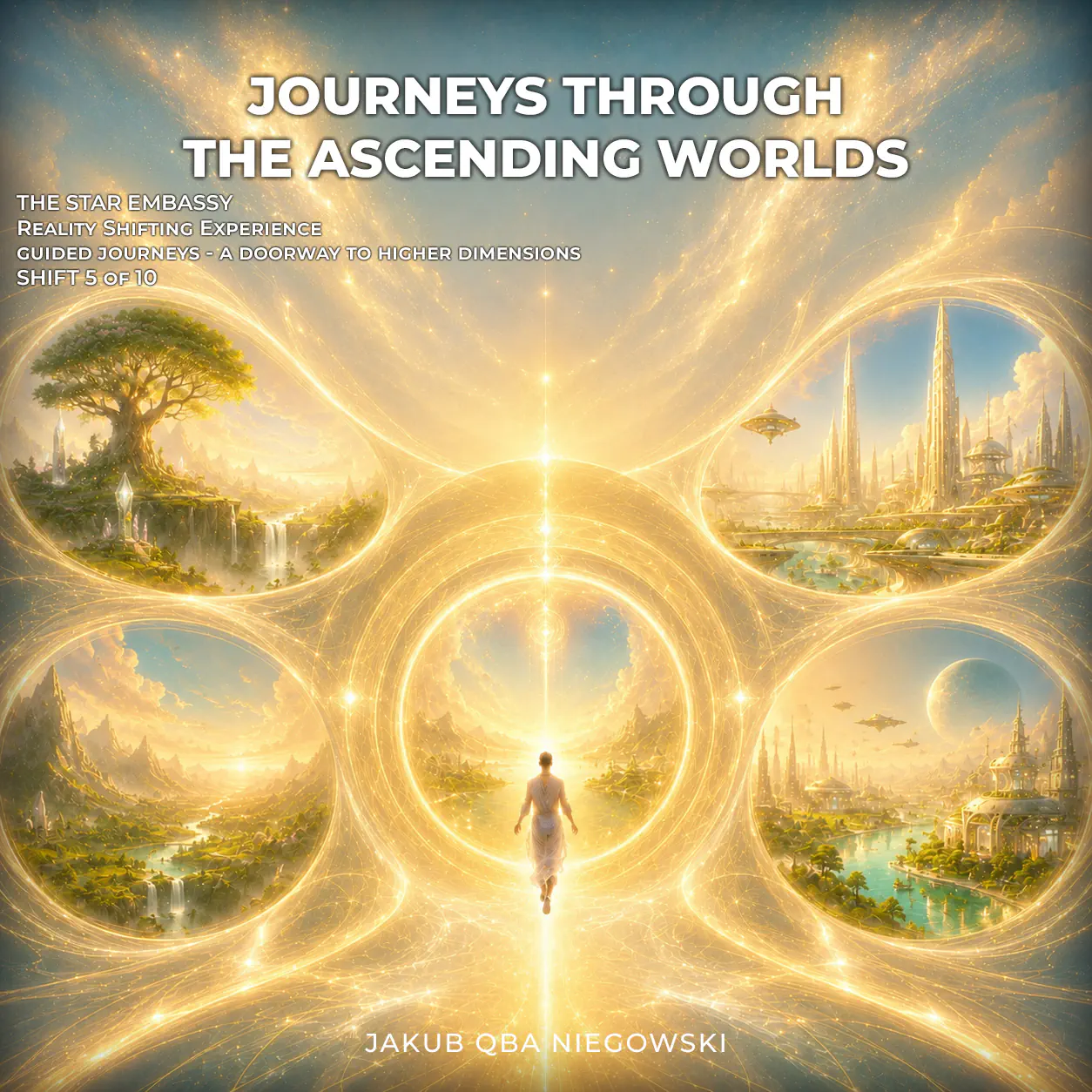
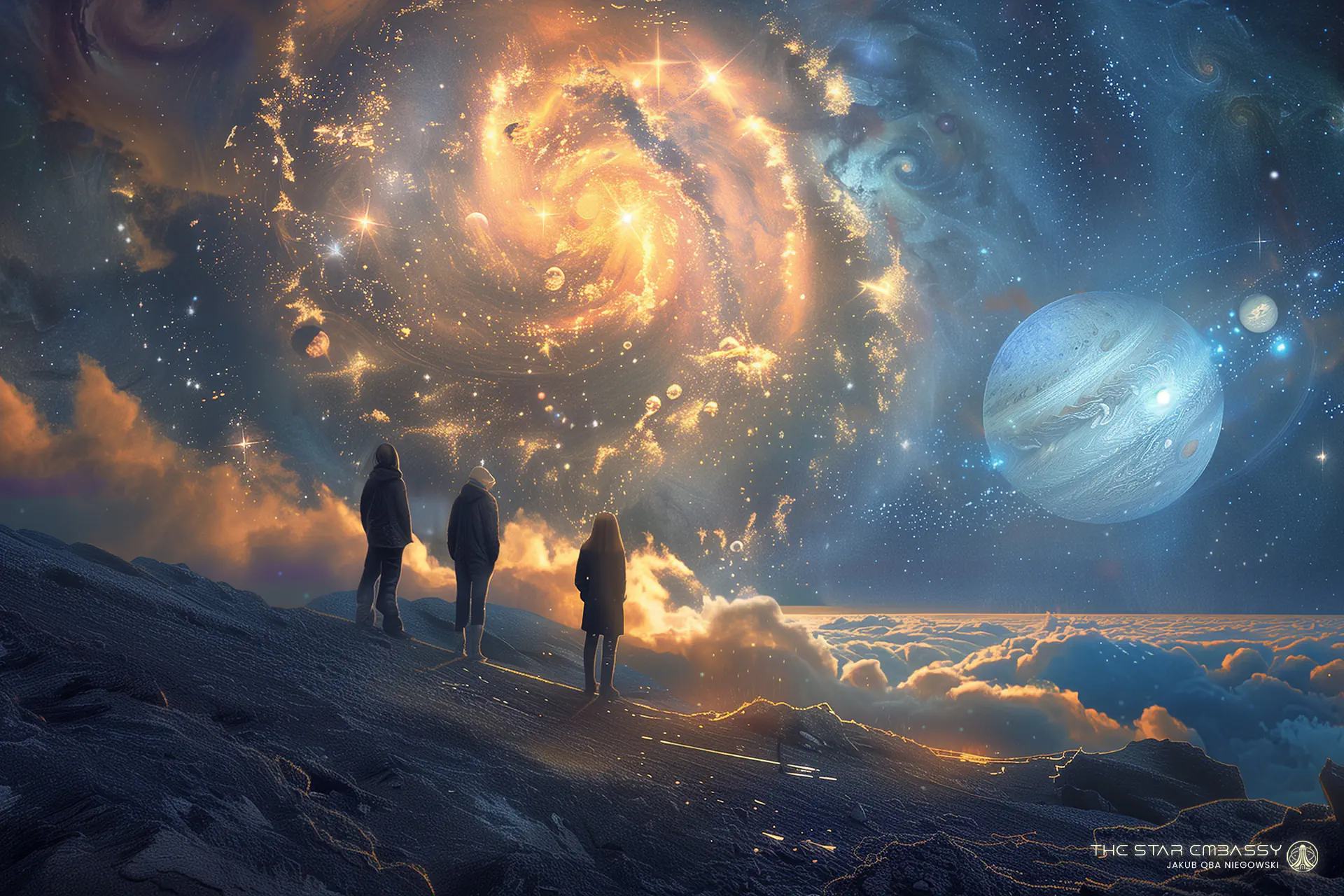
Parallel worlds are not merely a science fiction theme. According to both quantum physics and the oldest mystical traditions, the reality we know is one of an infinite number of versions of existence. Moreover, every human being is constantly moving between these versions – though the vast majority of us do so completely unconsciously. The key insight that changes how we understand our own lives is this: navigation between alternative timelines can be brought under conscious control. The primary instrument for doing so is the state of our consciousness and our inner vibration.
What Are Parallel Worlds and How Do We Know They May Exist?
Parallel worlds (also: parallel universes, multiverse) are hypothetical, co-existing realities in which reality branches at every possible event or decision.
This concept has solid foundations in physics. The Many-Worlds Interpretation (MWI), formulated by Hugh Everett III in 1957 and later developed by David Deutsch, proposes that at every quantum event where multiple outcomes are possible, all of them actually occur – each in its own branch of reality. From the perspective of any individual observer, only one branch is experienced. But all of them exist.
This is not fringe speculation. MWI is considered by many physicists to be the most mathematically consistent interpretation of quantum mechanics – precisely because it requires no “collapse” of the wave function. The branching simply happens, and each branch continues independently.
From the perspective of consciousness research and esoteric traditions, the picture is complementary: many systems of thought have long described reality as a field of possibilities that consciousness selects from and collapses into experience. What differs is the language, not the underlying structure.
The practical implication: if all versions exist, the question is not “how do I create a different reality?” but rather “how do I navigate to the version where what I seek is already present?”
Unconscious Navigation: How We Move Between Timelines Without Knowing It
Most people navigate between parallel versions of reality the same way they fall asleep – gradually, without noticing. The driving force is not intention but the aggregate of subconscious beliefs, habitual emotional states, and automatic expectations.
This creates a self-reinforcing pattern: we move within a narrow spectrum of nearly identical alternative realities. Reality shifts, but so gradually and smoothly that we have no felt sense of change. The same patterns repeat. The same types of situations arise. The same ceiling reappears.
Conscious work with one’s inner state can significantly expand this range – and shift the trajectory toward versions that would otherwise remain inaccessible.
How Do Consciousness and Vibration Affect Timeline Choice?
| Aspect | Unconscious Navigation | Conscious Navigation |
|---|---|---|
| Driving force | Subconscious beliefs and expectations | Intention + focused attention + will |
| Range of change | Narrow spectrum of similar variants | Access to significantly more distant variants |
| Speed | Slow, imperceptible | Accelerated with deep inner coherence |
| Tools | None – happens automatically | Meditation, belief work, conscious attunement |
The concept of “vibration” in this context refers not to a metaphysical abstraction but to a measurable pattern: the dominant emotional state, the characteristic internal frequency of an organism at a given moment. Research from the HeartMath Institute demonstrates that the heart’s electromagnetic field – the most powerful in the body – directly reflects emotional states and influences the environment at measurable distances.
The implication: changing your inner state is not merely a psychological act. It is a physical act with consequences that extend beyond the skin.
Why Do Billions of Human Beliefs Lock Us Into One Version of Reality?
This is one of the hardest-to-see mechanisms in navigating the multiverse.
Every person contributes their own pattern of expectations to the collective consciousness field. When billions of people share similar beliefs about how reality works – what is possible, what is not, what is “normal” – they create an enormously powerful collective filter that strongly narrows the range of available variants. From the earliest years of life, we program each other with a specific image of the world, and that image becomes a boundary beyond which most people never look.
This is why individual expansion of consciousness matters at a collective level. Each person who genuinely extends their perceptual range – who verifies through direct experience that reality is more fluid and more responsive than consensus declares – contributes to a shift in the collective field. Not through persuasion, but through the morphic resonance of their own changed state.
Practical Navigation: What Actually Changes the Timeline
The most common misunderstanding about timeline navigation is that it requires extraordinary effort – elaborate rituals, rare states, unusual abilities. The research picture suggests something different.
What matters most is inner coherence: the degree of alignment between what you consciously intend, what you emotionally expect, and what your body habitually enacts. When these three levels are in agreement – when intention, emotion, and soma all point in the same direction – the navigation becomes dramatically more effective.
The tools that reliably produce this coherence include:
- Meditation – specifically practices that train stable attention and reduce the automatic dominance of habitual thought patterns
- Belief work – identifying and revising subconscious expectations that contradict the intended direction
- Somatic practices – working directly with the body’s habitual emotional register, not just the cognitive layer
- Remote Viewing – a structured protocol for accessing information beyond the reach of ordinary sensory channels; simultaneously a tool for expanding what is considered “possible” through direct, verifiable experience
Sources
- Carroll, S. (2019). Something Deeply Hidden. Dutton. An accessible explanation of the many-worlds interpretation by a Caltech physicist.
- Institute of Noetic Sciences (IONS) – research on the influence of consciousness on physical reality: ions.org
- Princeton Engineering Anomalies Research (PEAR) – decades of research on the influence of intention on random physical systems: princeton.edu/~pear
- Everett, H. (1957). “Relative State Formulation of Quantum Mechanics.” Reviews of Modern Physics, 29(3), 454-462.
Frequently Asked Questions
Is the parallel worlds concept scientifically accepted?
The Many-Worlds Interpretation is a legitimate and widely discussed interpretation within physics, supported by researchers at major institutions including Caltech and Oxford. It is not the only interpretation of quantum mechanics, but it is considered by many physicists to be the most mathematically consistent one. “Accepted” in the sense of consensus – no. Taken seriously by serious physicists – yes.
Can I actually change which reality I live in?
The navigational model suggests that you are already doing this continuously. The question is whether you do it consciously or by default. The evidence from consciousness research – HeartMath, PEAR, IONS – points toward measurable relationships between inner state and experienced outcomes. The degree to which this constitutes “timeline navigation” in a literal sense remains open. What is not open is whether inner state affects experienced reality: it clearly does.
What is the first step in conscious navigation?
The most consistent finding across multiple traditions and research contexts is this: begin with attention. Specifically, with the practice of noticing what you habitually expect – not what you consciously want, but what you actually, bodily, expect. That gap between desire and expectation is the primary source of navigational friction. Closing it is the work.
Jakub Qba Niegowski – Extrasensory Awareness Development Specialist
To explore reality directly rather than only in theory, try our live online remote viewing course.