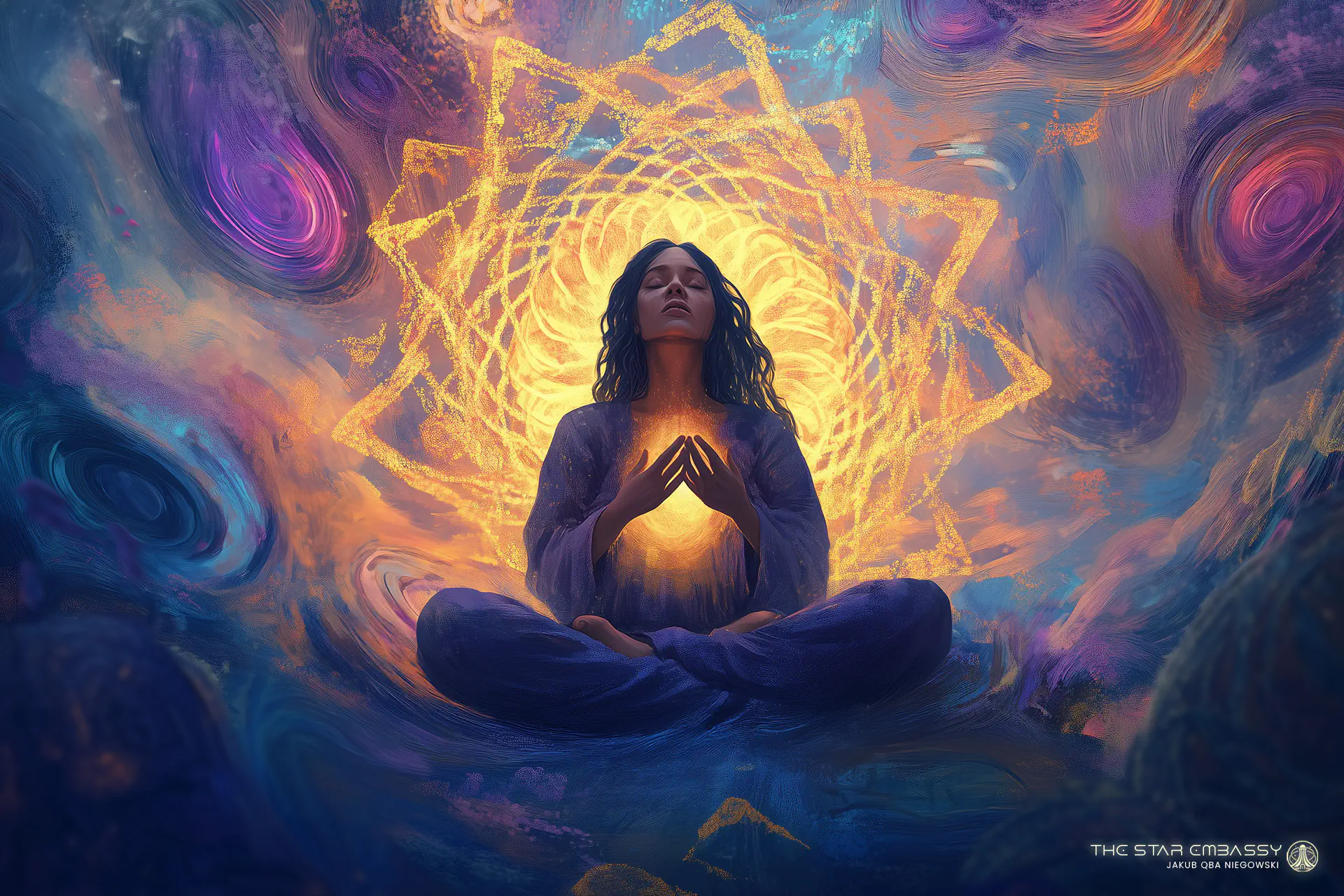
Reincarnation is the process by which consciousness (the soul), after the death of the physical body, incarnates again in a new form of life, continuing its evolution through successive cycles of existence. This is not merely an ancient religious dogma – it is a hypothesis that has been studied scientifically for over sixty years, and its traces may be alive in you right now: in unexplained fears, in talents that appear as if from nowhere, and in people you meet with the feeling that you have known them forever.
If you are wondering whether you really lived before – and what that would mean for your life now – you are in the right place.
What Is Reincarnation and How Do Previous Incarnations Work?
The word reincarnation comes from Latin: re (again) + in caro (into flesh). Literally: re-embodiment.
The idea is simple in its essence, but deep in its implications. Consciousness – what you truly are beyond body and mind – does not begin with birth and does not end with death. It passes through successive incarnations, carrying accumulated experience, unresolved patterns, and developing capacities. The body and personality change. The soul continues.
This idea is returning to mainstream culture – not only to esoteric circles. It is being revisited by psychiatrists, consciousness researchers, and a growing number of ordinary people who simply feel that their life did not begin from zero.
Is There Scientific Evidence for Reincarnation?
This is one of the most frequently asked questions. And there is an answer – though not the kind that academic mainstream expects.
The most serious body of evidence was assembled by Dr. Ian Stevenson – a psychiatrist and long-time chair of the Department of Psychiatry at the University of Virginia. For over thirty years he studied children who spontaneously described their previous incarnations – details that were verifiable and that the young child could not have known through any natural means.
Here is what Stevenson established:
- He studied over 2,500 cases of children describing previous lives across different countries and cultures.
- 1,567 cases were verified and confirmed by independent researchers.
- In many cases, children described birthmarks or physical defects that corresponded precisely to wounds from the death of the person whose life they were recalling.
- The cases came from cultures with no particular reincarnation tradition – which rules out cultural imprinting.
Stevenson’s work was continued by Dr. Jim Tucker at the same university, whose research is ongoing to this day.
Traces of Previous Incarnations – What Signs to Look For
Not everyone will have vivid memories of past lives. But the traces tend to be subtler – and more common than you might think:
- Unexplained phobias – an intense fear of water, heights, or enclosed spaces that has no basis in your current life experience.
- Innate talents – abilities that appear with no learning, as if the body simply already knows how.
- Inexplicable connections with people – the sense of knowing someone forever, even on a first meeting.
- Dreams that feel like memories – not typical symbolic dreams, but sequences of events from another era that feel genuinely real.
- Strong, irrational attraction to specific historical periods, cultures, or places – someone who has never been to Japan but has felt connected to it since childhood.
- Repeating patterns in relationships – the same dynamics, the same conflicts, the same people (in different bodies).
From the perspective of understanding consciousness as something non-linear and multidimensional, these traces make sense. Consciousness does not arrive empty. It brings with it a kind of luggage – both as resources and as unresolved material to work through.
What Happens to the Soul Between Incarnations?
This is one of those questions whose answer remains more in the domain of experience than of science – though accounts from widely different traditions and research show a surprising consistency.
The between-life phase is described as a time of:
- Life review – not in terms of moral judgment, but of insight: what was done, what remains unresolved, what was contributed.
- Planning the next incarnation – choosing context, conditions, and relationships that will allow the soul’s process to continue.
- Rest and integration – the duration of this phase varies greatly in reported accounts, from very brief to very extended.
How to Explore Your Previous Incarnations: Methods That Work
There are various paths to reaching memories of previous lives – and not all of them require expensive therapeutic sessions. Here are those I consider genuinely valuable:
1. Observing Your Own Patterns – Free and Underused
Start with the simplest: attentive self-observation. What themes repeat in your life? What situations do you avoid irrationally? Where do disproportionate emotions appear? These patterns are precisely the karmic traces waiting for integration – and no hypnotist is required to begin working with them.
2. Hypnotic Regression
A session with an experienced hypnotic regression therapist can bring consciousness into layers of memory inaccessible in ordinary states. Important: the quality of this method depends entirely on the competence of the therapist. A well-conducted regression can be a transformative experience. A poorly conducted one leads to confabulation and false memories.
3. Meditation with Intent
Deep, regular meditation aimed at insight – not quieting the mind – can gradually open access to non-sequential memories. The key here is neutrality: you are not looking for sensation, you are looking for understanding.
4. Somatic Work and Body-Based Introspection
The body holds energetic records. Some phobias, physical tensions, and blockages have roots deeper than this lifetime. Conscious, directed body work can reveal traces of earlier experiences.
5. Analysis of Relational Patterns
If the same conflicts, the same dynamics, and the same types of people keep appearing in your life – that is a karmic signal. Working with this material does not require knowing the details of previous incarnations. It is enough to understand what repeats and why.
Expert Insights: What You Won’t Read in Popular Articles on Reincarnation
Through years of working with consciousness and observing many people engaging with the subject of previous incarnations, three things stand out that are rarely addressed honestly.
The first is the trap of literal interpretation. Many people treat their impressions from past-life work as objective historical records. Meanwhile, consciousness does not work like a camera. What surfaces in regression or meditation is a mixture of genuine impression, symbolic content, and the filtering influence of the person’s own expectations and fears. The value lies not in whether it is “historically accurate,” but in what it reveals about current patterns. Working with those patterns – with fears, repeating dynamics, unintegrated material – can be transformative.
The second is romanticizing previous incarnations. The tendency to identify exclusively with “important” lives – priestesses, warriors, historical figures. Yet the value lies not in status, but in the lesson. An incarnation as an anonymous craftsman in a medieval village may carry a deeper teaching than a life in the brilliance of court splendor.
The third is understanding time. In the traditional view, incarnations are sequential – one after another. But from the perspective of advanced states of consciousness, time is far more non-linear than everyday experience suggests. Past, present, and potential future are not as separated as they seem. This opens a completely different understanding of what a “previous incarnation” even is.
Reincarnation Across Spiritual Traditions – A Comparison
| Tradition | Concept of the Soul | Goal of the Cycle | Exit from the Cycle |
|---|---|---|---|
| Hinduism | Atman (eternal, unchanging soul) | Moksha – union with Brahman | Liberation through knowledge and devotion |
| Buddhism | Stream of consciousness (not a fixed soul) | Nirvana – cessation of suffering | Awakening, resolution of karma |
| Jainism | Jiva – individual soul | Kaivalya – total freedom | Purification of karma through ahimsa |
| Theosophy | Monad evolving through incarnations | Perfection as being | Transition to higher planes of existence |
| Contemporary Parapsychology | Consciousness as a non-local field | Evolution of consciousness | Open question |
Why Understanding Reincarnation Changes How You Live
This is not written to convince anyone of a particular worldview. It is written because the difference is real – in how people function and approach life when they have genuinely worked through this subject.
When you understand that your life is not a single, random one-time attempt – something fundamental shifts.
Suffering stops being meaningless. It becomes the context of a lesson that has its own logic, even when it is hard.
Relationships take on depth. When someone arrives in your life carrying intense emotional weight, you can ask: what is the thread here? What is being continued or resolved?
Your talents feel like a responsibility. When you understand that certain abilities are carried from previous work and experience, you treat them differently – as something to develop, not simply possess.
The perspective lengthens. Regardless of whether reincarnation “really exists” – this framework generates a deeper, more conscious, and more responsible approach to life.
Sources and Research Worth Exploring
For those who want to go deeper using verifiable materials:
- Ian Stevenson – Twenty Cases Suggestive of Reincarnation (University Press of Virginia) | DOPS Research, Univ. of Virginia
- Jim Tucker – Life Before Life and Return to Life (St. Martin’s Press) – continuation of Stevenson’s research with contemporary cases
- Stanislav Grof – research on transpersonal and cosmic dimensions of consciousness, including experiences of unity with the Source: Grof Transpersonal Training
- Division of Perceptual Studies (DOPS) – University of Virginia research unit dedicated to scientific study of consciousness, NDE, and reincarnation: med.virginia.edu/perceptual-studies
FAQ – Most Frequently Asked Questions About Reincarnation
Is reincarnation scientifically proven? Not in the absolute sense. However, Dr. Ian Stevenson’s research at the University of Virginia – over 2,500 documented cases of children recalling verifiable details of previous lives – provides a serious empirical foundation that cannot be dismissed as anecdote. It is not proof in the physicist’s sense. It is evidence that demands serious consideration.
Does believing in reincarnation require a specific religion? No. Reincarnation appears across Hindu, Buddhist, Jain, and Theosophical traditions, as well as in contemporary scientific research on consciousness. You can engage with this topic from an entirely secular, evidence-based perspective.
What is the relationship between karma and reincarnation? Karma – in its original sense – means the consequences of actions: unresolved patterns, incomplete processes, relationships that carry unfinished threads. Reincarnation provides the framework within which karma continues and can be resolved.
Jakub Qba Niegowski – Extrasensory Awareness Development Specialist
To explore your own soul memory directly, our guided meditation recordings help you reach the receptive state where these impressions surface.